More than five years after the tragic murder of 19-year-old Jhanvi Kukreja on New Year’s Eve 2020, a sessions court is expected to deliver its judgment today. The case has gripped public attention for its brutal circumstances and the prolonged legal battle that followed.
Two young accused, Shree Jogdhankar, 26, and Diya Padalkar, 23, are facing murder charges. Padalkar was Jhanvi’s childhood friend and neighbour, adding a complex personal dimension to the case.
A Brutal Murder at a Year-End Party
How the Tragedy Unfolded
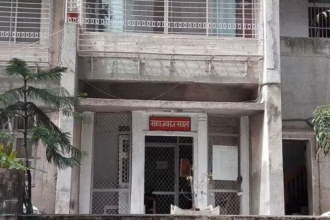
According to the prosecution, the incident occurred during a New Year’s Eve party held on the terrace of Bhagwati Heights in Khar.
Around 2.30 am on January 1, 2021, Jhanvi, a psychology student from Santacruz, was found dead in a pool of blood near the building’s staircase.
The prosecution claims that an argument broke out among the trio, allegedly over Jogdhankar’s personal relationship with Padalkar. Jhanvi was allegedly dragged down the stairs from the fifth floor, suffering 48 injuries, according to her post-mortem report.
Special public prosecutor Pradip Gharat highlighted that the nature of the injuries showed extreme brutality and that the crime was “heinous and barbaric,” causing irreversible trauma to the victim’s family.
The Accused and Their Claims
Padalkar and Jogdhankar’s Roles
Padalkar and Jogdhankar were arrested for their alleged roles in the assault and murder. While Jogdhankar remains in jail, Padalkar has been granted bail. Both have pleaded not guilty.
The prosecution alleges that Jogdhankar was seen leaving the building in a dazed condition, with bloodstains on his torn shirt. Meanwhile, Padalkar allegedly sought medical treatment for a lip injury sustained during the crime.
Defence Arguments
Jogdhankar’s lawyer, Wahab Kahn, has challenged the prosecution’s case, stating that it is entirely based on circumstantial evidence. He argued that there were no eyewitnesses and that the injuries were the result of a sudden altercation in the heat of the moment.
The defence also claims that the prosecution failed to establish a complete chain of evidence, which is legally required to prove guilt beyond reasonable doubt.
Evidence Presented by Prosecution
Witnesses and Forensic Reports
The prosecution examined 49 witnesses to build a chain of circumstantial evidence, supported by CCTV footage and forensic reports.
The Forensic Science Laboratory (FSL) reports revealed the presence of Jhanvi’s blood on Jogdhankar’s shirt and on objects handled by Padalkar. DNA profiling confirmed Jogdhankar’s presence at the crime scene and Padalkar’s contact with the blood-stained items, strengthening the case against them.
Special public prosecutor Gharat emphasized that the evidence conclusively establishes the involvement of both accused in the murder.
Family’s Plea for Justice
Jhanvi’s mother, Niddhi Kukreja, has repeatedly stated that she does not seek vengeance but demands dignity, closure, and justice. Through her lawyer, she submitted in court that the brutal nature of her daughter’s death underscores the need for the law to recognize the value of Jhanvi’s life and ensure accountability.
The Legal Battle Over Circumstantial Evidence
How Circumstantial Evidence Shapes the Case
One of the key points of contention in the trial has been the reliance on circumstantial evidence. While Jogdhankar’s defence argues that there are no direct eyewitnesses, the prosecution contends that the combined weight of forensic reports, witness testimonies, and CCTV footage forms a strong and credible chain.
Courts often rely on such evidence in complex cases where direct observation of the crime is not available, but the standard remains proving guilt “beyond reasonable doubt.”
Role of DNA and Forensics
The DNA and blood evidence played a critical role in linking the accused to the crime scene. According to the prosecution, Jogdhankar’s biological presence was confirmed through DNA profiling, while Padalkar was found to have handled blood-stained items in the aftermath of the crime.
Experts argue that such forensic evidence strengthens cases where witness accounts are limited or absent, providing objective support to circumstantial claims.
The Impact of the Case
Public Attention and Emotional Toll
The case has captured public attention not only because of its brutality but also due to the long wait for justice. The murder of a young woman by someone she knew personally adds layers of shock and complexity, highlighting issues of personal safety, violence among peers, and accountability.
For Jhanvi’s family, the past five years have been marked by grief, anxiety, and a constant hope for justice. The expected judgment today could finally offer them a sense of closure.
Lessons for Society
Experts and legal commentators say cases like these underscore the importance of prompt investigation, rigorous forensic work, and strong judicial oversight. They also highlight the emotional impact on families of victims and the need for the justice system to provide timely resolutions to violent crimes.
What to Expect Today
The sessions court is set to pronounce its verdict today. Observers expect the court to consider the circumstantial evidence, forensic reports, witness testimonies, and defence arguments before delivering a judgment that could either uphold or challenge the prosecution’s claims.
For Jhanvi’s family, the hope is that the court will acknowledge the gravity of the crime and ensure that justice is served, reaffirming faith in the legal process.
Closing Thoughts
The murder of Jhanvi Kukreja remains a tragic reminder of how quickly lives can be taken and how long families may have to wait for justice. As the legal proceedings reach their conclusion, the case continues to resonate in public discourse around crime, friendship, trust, and accountability.
While the court’s decision will not bring Jhanvi back, it may provide a critical measure of closure and serve as a warning against such heinous acts in the future.