Muslim Votes Split Among Non-BJP, Non-Shiv Sena Parties in Mumbai Civic Polls
The Municipal Corporation of Greater Mumbai (MCGM) elections once again underlined how important the Muslim vote is in the city’s political landscape. But this time, unlike earlier elections, the community’s votes were sharply divided among several non-BJP and non-Shiv Sena parties, influencing outcomes across multiple wards.
Mumbai’s Muslims, who make up a significant portion of the city’s population, did not rally behind a single political force. Instead, their support was spread across parties like the Congress, Shiv Sena (UBT), and the All India Majlis-e-Ittehadul Muslimeen (AIMIM), depending on local dynamics, candidates, and issues.
Why the Muslim Vote Matters in Mumbai
According to the 2011 Census, Muslims accounted for around 21 percent of Mumbai’s population, roughly 25.68 lakh people out of a total population of 1.24 crore. While the numbers may have changed over the last 15 years, the demographic composition of Muslim-majority areas has remained largely stable.
Across Mumbai, nearly 40 of the city’s 227 civic wards are considered Muslim-majority or Muslim-influenced. These include areas such as:
- Malwani
- Jogeshwari West
- Parts of Andheri West
- Bandra East
- Dharavi
- Mahim
- Byculla
- Mazgaon
- Bhendi Bazaar
- Nagpada
- Dongri
- Kurla
- Mankhurd
- Govandi
- Cheetah Camp
Because of this concentration, Muslim voters continue to play a decisive role in shaping civic election outcomes.
A Shift From Traditional Voting Patterns
Traditionally, Muslim voters in Mumbai have supported parties they consider secular, primarily the Congress and, at times, the undivided Shiv Sena. This pattern, however, has been gradually changing.
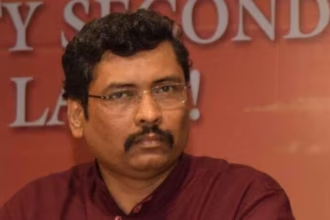
Zubair Azami, director of Urdu Markaz and a culture historian, explained that Muslim voting behaviour has evolved in response to changing political realities.
He noted that despite ideological contradictions in the past, Muslims had supported Shiv Sena candidates like Arvind Sawant and Manoj Jamsutkar to counter what they saw as a larger political threat. The emphasis, he said, was often on strategic voting rather than ideological purity.
However, recent political developments have disrupted that balance.
Impact of the Shiv Sena Split
One of the key reasons for the fractured Muslim vote was the split within the Shiv Sena.
After the division, the Shiv Sena (UBT) aligned with the Maharashtra Navnirman Sena (MNS), led by Raj Thackeray. This alliance proved uncomfortable for a section of Muslim voters.
According to Azami, many Muslims have long-standing reservations about Raj Thackeray due to his political rhetoric and positioning. Additionally, the Thackeray brothers were seen as focusing more on consolidating Marathi votes, leaving Muslim voters feeling sidelined.
As a result, a segment of Muslim voters moved away from Shiv Sena (UBT), looking for alternatives that they felt would better represent their concerns.
Congress, AIMIM, and Regional Choices
With no single party emerging as a clear choice, Muslim voters split their support based on local leadership, ground-level work, and perceived commitment to civic issues.
Congress Gains in South and West Mumbai
In several parts of south and central Mumbai, the Congress emerged as the preferred option. The party won seats in areas such as:
- Colaba
- Pydhonie
- Bhendi Bazaar
- Byculla
- Dharavi
- Sion
Congress candidates also secured victories in Bandra East and West, Kalina, Andheri West, Versova, and Malwani.
In many of these areas, voters said their choice was driven by long-standing neglect of basic civic infrastructure and a belief that Congress representatives would raise these issues within the civic body.
AIMIM’s Strong Performance in the Eastern Suburbs
In contrast, the eastern suburbs told a different story.
In Govandi and nearby areas, AIMIM made significant inroads, winning multiple seats and establishing itself as a strong alternative. According to Maulana Mahmood Dariyabadi, general secretary of the All India Ulema Council, AIMIM benefited from the Congress not campaigning aggressively in these areas.
AIMIM’s focused ground-level presence, direct engagement with voters, and strong anti-incumbency narrative helped the party gain trust, particularly among younger voters.
Voters Speak: Issues Over Identity
Many Muslim voters insisted that their decisions were based on civic concerns rather than religious identity alone.
Sadique Qureshi, a 46-year-old advocate from Malwani, where Congress candidate Rafique Shaikh won, said voters were frustrated with years of neglect in Muslim-majority areas.
He pointed out that basic issues such as sanitation, roads, water supply, and housing had remained unresolved for decades. According to him, supporting the Congress candidate was both a protest against neglect and a strategic move to prevent candidates with hostile rhetoric from winning.
Similarly, Faiyaz Alam Shaikh, a 30-year-old resident of Shivaji Nagar, explained why he supported AIMIM. He said the party openly challenged sitting leaders, built strong momentum on the ground, and connected with voters through consistent engagement.
For many like him, trust was built through visibility and accountability rather than party legacy.
Fragmentation Helped the BJP Indirectly
While Muslim votes largely stayed away from the BJP and the Eknath Shinde-led Shiv Sena, their division among multiple opposition parties indirectly benefited the BJP in several wards.
In close contests, the split reduced the opposition’s ability to consolidate votes, allowing BJP candidates to gain an edge even in areas where the party traditionally struggled.
Political observers note that this fragmentation reflects not apathy, but a more complex and localized decision-making process among voters.
A Clear Message From the Electorate
The 2026 BMC elections sent a clear message: Muslim voters in Mumbai are no longer voting as a single bloc. Instead, they are making calculated choices based on local leadership, civic performance, alliances, and perceived respect for their concerns.
This shift presents both a challenge and an opportunity for political parties. Those who fail to engage meaningfully with Muslim-majority areas risk losing relevance, while parties that invest in consistent grassroots work stand to gain.
A More Nuanced Political Landscape
The division of Muslim votes in Mumbai’s civic elections highlights a maturing and more nuanced political behaviour. Identity remains important, but it is no longer the sole factor driving electoral decisions.
As Mumbai moves forward under a new civic leadership, the message from Muslim-majority wards is unmistakable: performance, presence, and accountability matter more than slogans or legacy.