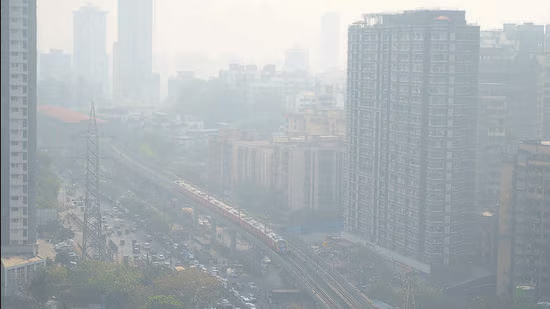
Mumbai is going through one of the worst air-quality phases in recent years, which has sparked public frustration, political finger-pointing, and now intervention by the Bombay High Court. While the AQI was sliding into “poor” and “very poor” categories across many monitoring stations, there grew an increasing sense of concern that the city was neither adequately prepared nor very willing to implement stringent pollution-control measures. The court, taking suo motu cognisance of the deteriorating conditions, has now called out what it describes as a “pattern of excuses” from authorities while citizens continue to breathe toxic air.
Court Rejects the “Volcanic Ash” Argument
Among the highlights of the week’s hearing was the court rejecting the state government’s contention that wind-borne volcanic ash from Ethiopia was one of the prime causes of this year’s surge in pollution. The court made it clear that Mumbai’s AQI was already poor long before the volcanic activity, hence it is a scientifically weak and administratively irresponsible argument.
The bench criticized officials for “externalising blame” rather than accepting the presence of systemic problems such as unregulated construction dust, open waste burning, stalled emission-control projects, and lax enforcement of existing guidelines. “If such excuses are entertained, no real action will ever be taken,” the court remarked, indicating it is inclined to push for long-term structural corrections.
High Court Appoints an Independent Committee
The Bombay High Court took a final step and formed an independent committee of five members which shall comprise experts from the Brihanmumbai Municipal Corporation, the MPCB, the public health department, and environmental experts.
This committee shall be responsible for:
Carrying out on-ground inspections at major construction sites
Assessing compliance with dust-control norms
Checking the installation of anti-pollution equipment like sprinklers, barricades, and wind-breaking screens.
Local hotspots contributing disproportionately to pollution could be identified.
The panel has to submit its preliminary findings within a tight deadline, signaling the urgency the court expects from civic bodies.
BMC Crackdown: 53 Construction Sites Hit With Stop-Work Notices
The BMC has now stepped up its inspections across various ongoing construction and infrastructure projects following the severe observations made by the court. As many as 53 construction sites across Mumbai were slapped with stop-work notices in the last 48 hours, for failing to comply with basic anti-dust norms such as covering debris, installing sprinklers or erecting proper barricades.
All these were major constructions in suburbs and central Mumbai-an area that has seen particularly alarming AQI readings. According to BMC officials, more sites could be scrutinized over the next few days, while repeat offenders could be fined or have projects suspended, or even be taken to court.
Public Health Concerns Escalate
Medical specialists across Mumbai have issued caution advisories amidst a noticeable spike in complaints related to respiratory problems. Hospitals report a rise in asthmatic attacks, wheezing, allergic bronchitis, eye irritation, and general breathlessness — particularly among children and senior citizens.
Mumbai has, in the past, enjoyed more favourable coastal winds and better dispersion of pollutants compared to Delhi. However, the past couple of winters have witnessed worrying patterns of stagnant air, mingled with dust-heavy development work, exhaust emissions, and construction around large infrastructure projects, including the coastal road, metro lines, and tunnels.
Political Reactions and Public Pressure
While the opposition leaders blame the state’s governance for being in “denial mode,” environmental activists say that Mumbai is paying the price for rapid construction without proper environmental planning. Citizens have also taken to social media, demanding that the authorities deploy more air purifiers near high-traffic and school zones, ban open burning, monitor construction strictly, and publish real-time accountability reports.
Several residents’ associations are also contemplating filing more public-interest litigations seeking weekly progress reports from BMC and MPCB.
What Lies Ahead for Mumbai? The intervention of the court is thus a turning point-from excuse-making to accountability. The newly formed inspection committee, together with BMC’s stricter enforcement, may discipline the pollution-heavy sectors. However, as experts caution, unless Mumbai builds sustainable and long-term frameworks like cleaner public transport, green buffers, dust-free construction technology, and active emission monitoring, the crisis may deepen in coming winters. As Mumbai stands shrouded in haze, the message from the court comes out loud and clear: the city can no longer afford complacency. Steps taken over the next few weeks will determine whether Mumbai can breathe easier-or whether this phase of pollution becomes its new normal.