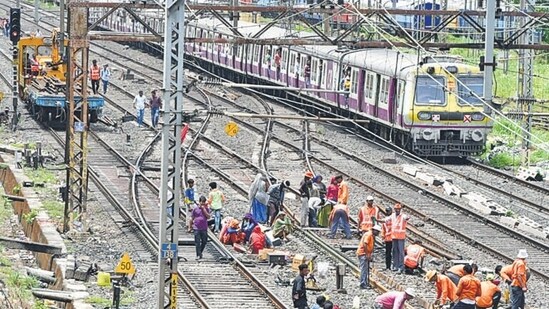
The lifeline of the city faced severe pressure on Tuesday due to a signal failure on the Western Railway line of the local trains, which resulted in chaos for commuters during peak office-going hours. Thousands of commuters were left stranded on the platforms as several trains were delayed or ran late due to the signal failure.
According to information from the Western Railways, the problem arose due to a technical issue that resulted in fewer train movements because of safety reasons between the important parts of the suburban stretches. The technical issue was reported early morning, roughly around the peak rush hour times, thus escalating the situation severely. Measures were taken immediately by the respective authorities, and train operations were reduced with a view to avoiding any adverse event.
Passengers alighting or boarding the trains from main stations including Churchgate, Dadar, Andheri, Borivali, and Virar experienced overcrowding to the maximum capacity. Those train services that ran were jam-packed to the brim, causing commuters to wait for long hours. Some commuters experienced waiting times to the tune of 30 to 45 minutes, while other commuters relied on other means, including the use of overcrowded roads in Mumbai.
This resulted in cascade delaying effects on the trains, with both the fast and slow local trains being affected. Some sections were manually controlled by the train operators under controlled circumstances. This is an activity that slows down the train frequency significantly but ensures the safety of the commuters. The safety of commuters was the priority, with the trains only being cleared to move by the control room.
This resulted in massive congestion along arterial roads running parallel to the Western line, such as the Western Express Highway and SV Road, as people opted for buses, taxis, and cab services. The BEST buses were also packed, and taxi prices skyrocketed. The traffic police were placed at major crossings to control the situation and ensure easy flow of vehicles.
The Western Railway posted updates on the delay of the train services on social media sites and through announcements, requesting passengers to adjust their travel plans accordingly. Railway officials confirmed that experts were working on a war footing to detect and resolve the problem. Spare equipment for signaling was used, and extra personnel were employed to expedite the repairs.
Passenger groups and regular commuters were disheartened by the fact that this is not an isolated incident and prompted questions as to the dependability of the Mumbai suburban railway network, even as it is one of the most important means of moving over seven million passengers every day. There were demands for fast tracking improvements for the signalling systems and communication with commuters in an emergency situation.
By late morning, some sections had reported the restoration of levels of service, though delays continued as the pattern of train service remained irregular. It was expected to take a number of hours to revert back to normal levels, as the backlog train service had to be cleared. Rail customers should be mindful of announcements made with regard to travel.
According to experts, although signaling modernization work is underway on several routes of the Mumbai suburbs, “transitional phases can be a problem from an operational standpoint.” They emphasized the need for effective backup systems and “predictive maintenance” to avoid “disruptions” in the “economic and social rhythms” of a big city like a metropolitan center such as Mumbai.
Experts further said that although signaling modernization is essential for As Mumbai is slowly moving back to normalcy, the episode has again reminded us of the vulnerability of Mumbai’s lifeline network. For people who use local rail networks daily, a small technical problem means waiting for hours. Thus, the need to have a resilient rail network is more than ever.