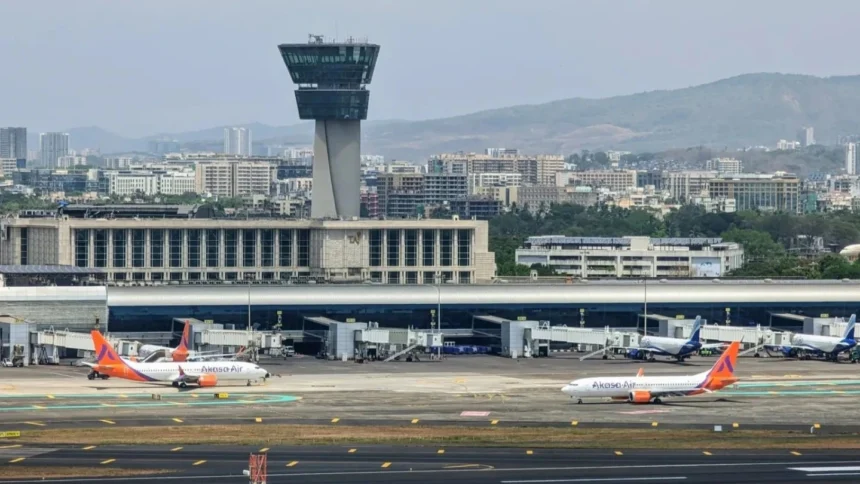
In a feat that showcases Mumbai’s rapidly growing aviation footprint, the Chhatrapati Shivaji Maharaj International Airport has created a new global record for the most flights handled by any single-runway airport in one day. Mumbai, which clocked a record 1,036 aircraft movements, has surpassed previous benchmarks and reaffirmed its position as one of the world’s most efficiently managed airports.
This milestone, recorded earlier this week, has cast a spotlight on the aviation capabilities of Mumbai, especially in view of infrastructural and geographical limitations that restrict the airport to operating primarily on a single active runway at any time.
A feat of precision & coordination
Unlike multiple-runway airports, CSMIA relies on tight coordination, time-bound scheduling, and high-efficiency ATC to deal with soaring volumes of flights. According to airport officials, the record resembled a “symphony of precision” as ATC, ground staff, airlines, and technical teams moved in complete tandem.
The runway handled a mix of:
Domestic arrivals and departures
International long-haul flights
Aircraft cargo
Business aviation traffic
Every movement had to be slotted at carefully planned times, particularly during morning and evening peak hours – the busiest time for Mumbai’s skies.
Why Mumbai’s Achievement Is Unique
Such high operational figures are rarely achieved by single-runway airports due to safety protocols, traffic spacing requirements, and variable weather. What makes the achievement of Mumbai particularly notable is:
- Space Constraints
Situated within the thick suburb of Andheri, CSMIA has little room for physical expansion. Moreover, the cross-runway configuration limits simultaneous operations.
- Heavy Demand by Passengers
Mumbai is the financial capital of India, a global business hub, and one of the busiest domestic destinations. The demand remains high, and flight schedules are heavily packed.
- Turnaround Efficiency
Airlines operating from Mumbai, especially domestic ones, follow strict turnaround times for allowing more movements within the same time frame.
- ATC Excellence
Air traffic controllers in Mumbai are considered among the most efficient in the world and often handle more aircraft in one hour than many dual-runway airports.
Cumulatively, these factors demonstrate how Mumbai can accomplish more with less— something envied by the global aviation community.
Passenger Traffic Growth from 2023 Surge
The record comes amidst a continuing surge in passenger traffic after the pandemic. According to the airport authorities, Mumbai has witnessed:
Sustained 15–20% growth in domestic passengers
Sharp revival in international traffic, particularly to the Middle East, South-East Asia, and Europe
Activation of new routes by Indian and foreign carriers
Growing number of business travelers and cargo flights
IndiGo, Air India, Vistara, Emirates, and Qatar Airways, among others, have increased operations and are major contributors to the increase in movements.
Operational innovations behind the record
CSMIA has implemented several innovations to support rising demand while not compromising safety:
Advanced Instrument Landing Systems (ILS)
This improves runway utilization under low visibility conditions.
A-CDM ⦿ Enhanced Airport Collaborative Decision Making
Real-time coordination among airlines, ATC, and ground teams to reduce delays.
Digital Queue Management
Optimizes taxiway traffic and sequencing.
High-Speed Rapid Exit Taxiways (RETs)
Allows aircraft to clear the runway more quickly after landing, making room for the next movement.
These systems together help maintain runway occupancy time among the lowest in Asia.
The Path Ahead: Capacity Expansion in View
Though the record reflects Mumbai’s operational brilliance, experts warn that demand will soon outpace capacity. With a fast-growing economy and rising regional air travel, the pressure on CSMIA will continue to mount.
To address this:
Navi Mumbai International Airport is under development to share the traffic load.
Terminals and infrastructure are being improved and expanded phase-wise.
The airlines are looking at more wide-body operations from Mumbai to reduce frequency and increase capacity.
Once NMIA becomes operational, the two airports are expected to function in a dual-airport model similar to major global cities.
A Proud Moment for Indian Aviation That is not a statistic alone but a world record symbolizing Mumbai’s spirit, resilience, and efficiency in outpacing global airports despite constraints. For lakhs of passengers who fly through this gateway every day, the achievement is reflective of the city’s unyielding spirit and India’s fast-growing aviation sector. As Mumbai continues to soar, this milestone stands tall as evidence that world-class performance is possible even within tight limitations—where precision, innovation, and determination come together in the sky above India’s financial capital.