Mumbai, 11 November 2025 – Christian organisations and community leaders across Mumbai have expressed deep concern over the proposed Maharashtra Freedom of Religion Bill, cautioning that it would inadvertently criminalise acts of charity and kindness. The bill is scheduled to be tabled in the Maharashtra Legislative Assembly to regulate religious conversions but has sparked debates on civil liberties and minority rights.
The proposed legislation attempts to prevent conversions made under “inducement, force, or fraudulent means.” While the intent of the bill, according to its proponents, is to protect individuals from coercion, critics say the language in the legislation is imprecise and could have unintended consequences for charitable and social work. “Giving food, shelter, education, or health could be misconstrued as inducement for religious conversion under this law,” said a representative of a Mumbai-based Christian NGO.
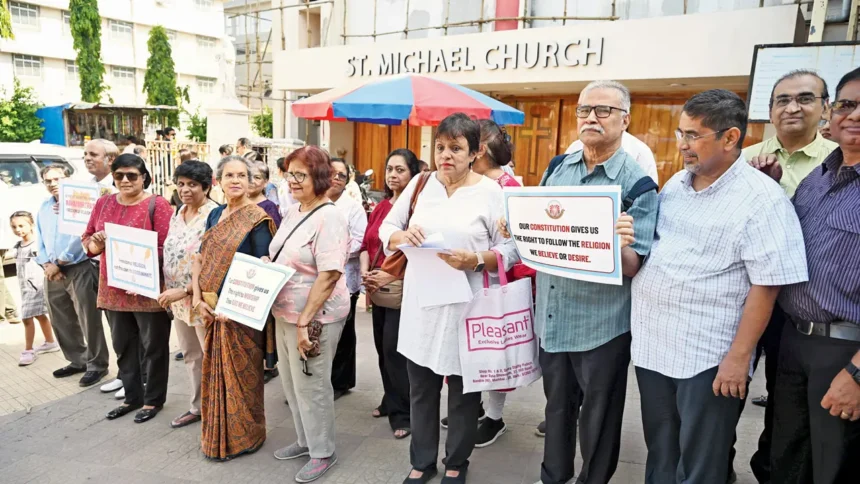
Community leaders from across the Mumbai Metropolitan Region have led public demonstrations and delivered petitions to the Chief Minister requesting consideration for revision and serious reevaluation of the bill. They asserted that the legislation, if passed in its present form, could curtail freedom of conscience and damage India’s constitutional pledge for religious liberty. “Acts of kindness should never be treated as criminal,” said Father Thomas D’Souza, a senior clergy member in Mumbai. “We fear ordinary social service activities could be criminalized, which would have a negative impact on vulnerable communities.”
The bill is mired in controversy amidst a broader national debate on religious freedom and minority protection. Maharashtra has always been at the epicenter of debates on communal harmony, given its very large population with various segments. Proponents of the bill claim it will stop the so-called forced conversions and save people from being manipulated into changing religions, especially among underprivileged groups. The opponents maintain that coercion is taken care of by the laws already in place and any further restrictions are uncalled for and may be harmful.
Legal experts have weighed in on the potential implications, too. As constitutional lawyer Meera Joshi explains, “The wording of the bill could lead to overreach. Courts may be forced to determine if basic humanitarian aid is considered inducement, which puts NGOs and charities under potential legal jeopardy.” Several Mumbai-based organizations have said that they may suspend operations of some kinds until clarification is provided, fearing prosecution under the new law.
The Maharashtra government has hinted that the bill is still under consideration and the public feedback will be considered before its final presentation. According to the officials, “While there is a need to provide protection against coercion, the government also wants to ensure that constitutional freedoms are not hampered. “We want to ensure that no one is forced to change their religion against their will, but at the same time, we do not intend to criminalize acts of genuine service,” said a government spokesperson.
Public opinion is divided in Mumbai. Some welcome the stronger restrictions, which would help stem coercion, especially in sensitive areas where conversion has long been a source of friction. Others fear the law will perpetuate an atmosphere of fear and suspicion and will discourage community involvement or interfaith cooperation. “This is not about stopping religious practice—it is about protecting civil liberties while maintaining social harmony,” said Anjali Deshmukh, a community activist.
This delicate balance is captured in the proposed Freedom of Religion Bill. For NGOs, religious organizations, and social workers operating in Mumbai, the potential ramifications are great. Many are paying close attention to developments, preparing themselves to adapt operations so that, under the change in legal dynamics, the continuum of service to their communities may remain intact.
In conclusion, the Christian and other minority communities of Mumbai have demanded the bill be reconsidered with greater care, arguing that humanitarian work should not be penalized. As debates continue, all eyes are on Maharashtra’s legislature to draft a law that efficiently deals with coercion without clamping down on religious freedom or restricting charitable initiatives. The forthcoming weeks will prove vital in determining whether the bill can achieve this delicate balance while upholding public trust and communal harmony.