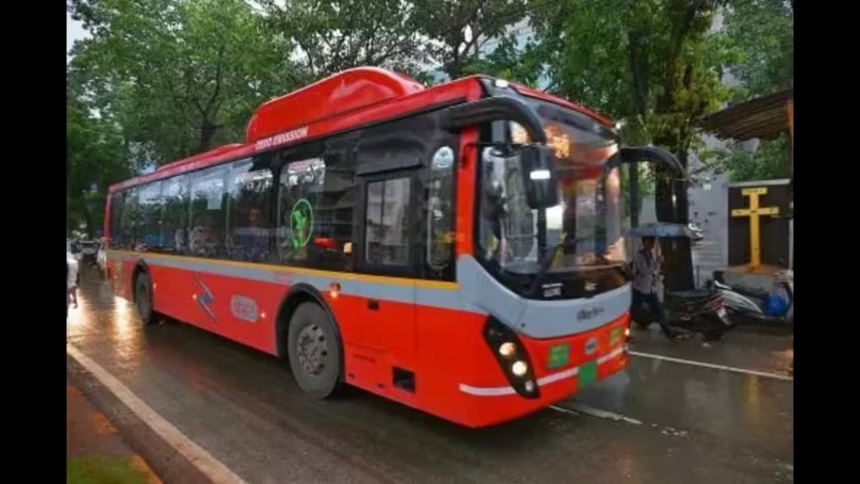
One of the major facelifts that Mumbai’s public transport system has seen over the past few years is at the hands of the Brihanmumbai Electric Supply and Transport (BEST) undertaking. The undertaking is going all out to modernize, streamline, and make daily commuting comfortable across India’s financial capital by introducing a new AC route, A-101, connecting CSMT to Cuffe Parade, while revamping 23 other routes.
This big overhaul, which includes making eight non-AC routes air-conditioned, has been done to make the travel mode more convenient, dependable, and eco-friendly for commuters. However, while office-goers and frequent travelers have welcomed the move, it also generated some discontent among the residents of the city as, in the process of reorganization, it removed or relocated some stops.
A New Wave of AC Connectivity
The newly introduced A-101 AC route from CSMT to Cuffe Parade has been strategically designed to meet the requirements of Mumbai’s busy workforce. It connects two of the most high-traffic zones in South Mumbai, making it especially useful for daily commuters who travel between commercial hubs and governmental offices.
Besides A-101, BEST has undertaken a systemic restructuring of as many as 23 routes within the city. These changes are part of a more comprehensive strategy in order to get rid of route duplication and redundancy and improve efficiency. Long and underutilized routes have been curtailed or reshaped to align better with passenger demand and road conditions.
Eight popular non-AC routes have now been upgraded to fully air-conditioned services, a step toward greater comfort and better air quality inside buses. This change has come at a time when high air pollution and rising heat levels in Mumbai are raising demand for cleaner, more comfortable modes of public transport.
Balancing Efficiency and Accessibility
While the overhaul has been portrayed as a progressive move, not all responses have been positive. Some commuters, especially in neighborhoods where stops were removed, voiced frustration over reduced accessibility. For many senior citizens and schoolchildren that depend heavily on nearby stops, the new system meant longer walks and greater inconvenience.
BEST officials justified the reorganization, saying that the motive for it is to streamline the operations, reduce congestion at crowded stops, and ensure punctual services. “Our intention is to make public transport smoother and more dependable. Adjustments to stops and routes are made after analyzing the ridership data, road capacity, and commuter feedback,” explained a BEST spokesperson.
The authority further assured that feedback from passengers will continue to shape changes in the future and hinted that fine-tuning routes could happen once the new network is in place.
The Push toward Modern Public Transport
BEST has been working on an overhaul of its bus network besides the broader modernization, which involves adding more electric buses to its fleet and integrating digital ticketing systems. BEST plans to convert a major part of its fleet to electric by 2027 with the growing use of EVs in order to minimize carbon emissions.
Additionally, the emphasis on air-conditioned and electric buses shows the growing effort toward making Mumbai’s public transportation system sustainable and commuter-friendly. These developments align with the larger goals of the city in promoting green mobility, easing road congestion, and encouraging its citizens to use public transport instead of private vehicles.
Commuters’ Response and the Road Ahead
Reaction to the AC route launch has been mixed so far. Many office-goers have welcomed the change, appreciating the comfort and cleaner travel environment, especially during peak hours. “Traveling from Cuffe Parade to CSMT has never been this pleasant. The AC buses are punctual and worth the slight fare increase,” said a commuter, adding that the improved comfort justifies the cost.
On the other hand, some daily passengers are still adjusting to the new routes and stop locations. BEST officials have stated that passenger data from the first few weeks will be closely monitored, with further modifications based on usage trends.
With Mumbai proceeding on its course of expansion commercially and residentially, efficient and comfortable public transport remains a very important part of metropolitan living. The new AC services and route restructuring mark an important milestone in BEST’s evolution from a legacy public bus provider to a modern, technology-driven urban transport system.
Conclusion The continuous bus network revamp at BEST is not only an infrastructural upgrade but a mindset shift in the way Mumbai approaches mobility. By putting commuter comfort, sustainability, and route efficiency on priority, BEST is making a bold leap toward a cleaner, smarter, and more reliable transport future for Mumbai. Though it is an uphill task to balance convenience and efficiency, the initiative shows that the red buses are not part of Mumbai’s retro history but a dynamic, ever-evolving lifeline to this city.