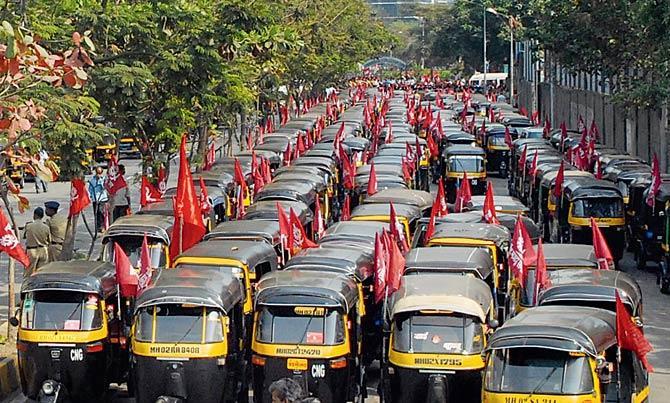
Mumbai, August 24, 2026: A section of autorickshaw and taxi drivers in Mumbai began a three-day strike on Monday, protesting the Maharashtra government’s enforcement of a Marathi language requirement for drivers. The protest has disrupted local transport in parts of the Mumbai Metropolitan Region, with commuters reporting shortages of autorickshaws and taxis on several routes.
Drivers Protest Marathi Requirement
The agitation comes after the Maharashtra Transport Department intensified checks requiring auto-rickshaw and taxi drivers to demonstrate a working knowledge of Marathi, the state’s primary language. Authorities have been conducting verification drives, with drivers who fail to meet the requirement facing notices and possible regulatory action.
Protesting drivers, particularly those who do not speak Marathi fluently, argue that the implementation places an additional financial and administrative burden on them. Some drivers have also expressed concern that penalties could affect their ability to earn a livelihood.
The government, however, has maintained that the language requirement is intended to improve communication between public-transport drivers and passengers and to ensure compliance with existing conditions for operating commercial vehicles in Maharashtra.
Kandivali Road Blocked During Protest
The strike became particularly visible in Kandivali, where protesting drivers blocked the Kandivali Link Road. The road disruption affected traffic movement and added to difficulties for commuters trying to reach railway stations and other transport connections.
The shortage has been particularly noticeable on feeder routes connecting residential neighbourhoods with railway stations. Since autorickshaws form an important part of Mumbai’s last-mile transportation network, even a partial withdrawal of vehicles can quickly create longer waiting times and increase pressure on buses, trains and app-based services.
Reports also indicated that some drivers were avoiding certain routes because of concerns about enforcement checks. This has contributed to reduced availability even beyond areas where direct protests were taking place.
Government Enforcement Intensifies
The protests follow an enforcement drive that began earlier this month. The state has been checking whether drivers meet the Marathi-language requirement, while new applicants for auto and taxi badges are also subject to language verification.
According to Maharashtra Transport Minister Pratap Sarnaik, around 1.65 lakh drivers have undergone Marathi training and received certificates. The state has around 9.65 lakh auto-rickshaw and taxi drivers, highlighting the scale of the verification process.
The government has also introduced a videographed verification process for new auto-rickshaw and taxi driver badges, with the stated aim of making assessments more transparent and consistent.
Commuters Face Higher Fares and Longer Waits
For Mumbai commuters, the immediate impact has been a reduction in available autos and taxis. Passengers who normally depend on autorickshaws for short-distance journeys have been forced to wait longer or seek alternatives such as buses, local trains and app-based cab services.
Reports have also emerged of commuters paying substantially higher fares in areas experiencing a shortage of vehicles. The disruption could become more pronounced if the three-day strike continues across additional parts of the city and neighbouring areas.
The protest has also produced isolated confrontations. Police are investigating an incident in which an autorickshaw driver was reportedly assaulted amid tensions surrounding the language-rule protests.
Strike Puts Policy Under Spotlight
The three-day agitation has brought the wider debate over language, employment and public transport regulation back into focus. Drivers opposing the rule are seeking relief from what they describe as difficult enforcement conditions, while the government is defending Marathi proficiency as a requirement connected to public-facing transport services.
With the strike expected to continue for three days, Mumbai commuters will be watching closely for any further disruption. The immediate challenge for authorities will be to maintain public transport availability while managing the dispute between drivers and the state over implementation of the Marathi-language requirement.