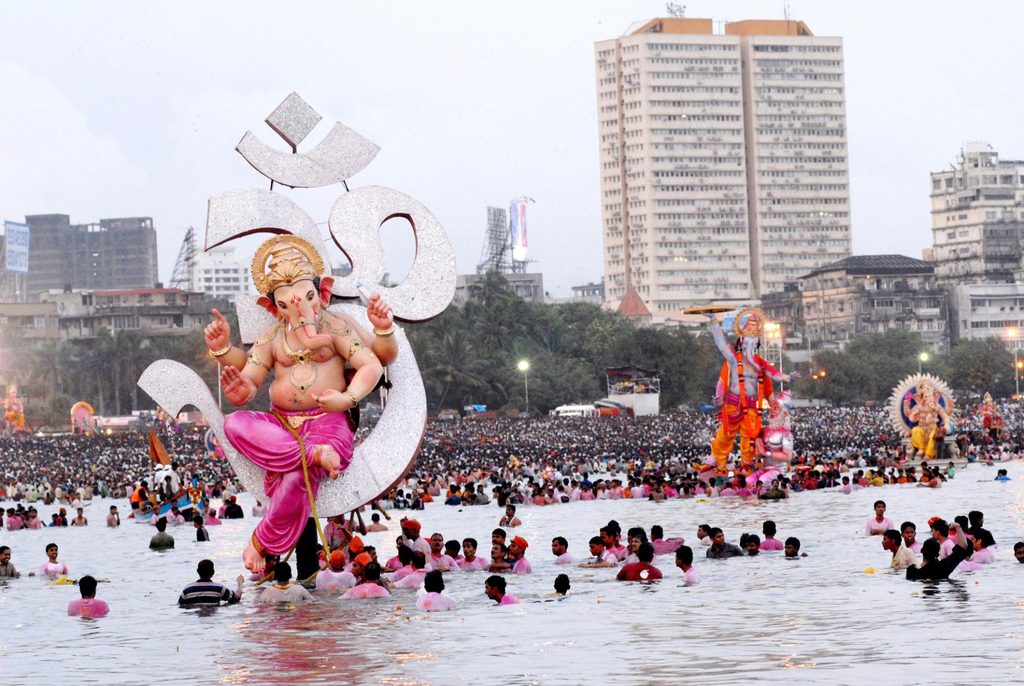
MUMBAI, August 21, 2026: The Bombay High Court has clarified that its six-feet rule for Ganesh idol immersion will remain in force during this year’s Ganesh Chaturthi celebrations, keeping restrictions on the immersion of idols in natural water bodies amid continuing concerns over pollution caused by Plaster of Paris (PoP). The clarification means Ganesh idols measuring up to six feet must be immersed in artificial water bodies, while larger idols can be immersed in natural water bodies subject to the applicable conditions.
The issue has been under consideration before the court for several months, with environmental activists seeking stricter implementation of Central Pollution Control Board (CPCB) guidelines and the Maharashtra government requesting permission to continue its existing policy. The court has reserved its final verdict on petitions seeking a complete ban on PoP idol immersion in natural water bodies.
Six-Feet Threshold Continues
The Bombay High Court’s clarification follows its interim arrangement issued in July 2025. Under that framework, idols up to six feet in height are required to be immersed in artificial ponds or tanks, rather than rivers, lakes or the sea. Idols exceeding six feet may be permitted for immersion in natural water bodies where the stipulated conditions are met.
The arrangement was introduced as an environmental safeguard intended to reduce the impact of idol immersion on natural water bodies. The court had stressed that local authorities must make adequate artificial immersion facilities available and ensure that the policy is implemented properly.
The Maharashtra government had sought continuation of the arrangement for the 2026 festival, arguing that an immediate complete ban on PoP idols would be difficult because many idols had already been manufactured.
PoP Pollution Remains at the Centre
The dispute primarily concerns Plaster of Paris idols, which environmental petitioners say can cause significant pollution because the material does not dissolve quickly in water. The petitions before the court seek effective implementation of CPCB recommendations that favour eco-friendly materials and oppose the immersion of PoP idols in natural water bodies.
The state, meanwhile, has maintained that a complete phase-out of PoP idols will require time. During hearings, Maharashtra told the court that it would need around three years to gradually phase out PoP idols, while promoting clay and other environmentally friendly alternatives.
Court Pushes for Eco-Friendly Celebrations
The court has also explored alternatives that could preserve religious traditions while reducing environmental damage. In July, the bench suggested that large PoP idols could undergo a symbolic immersion, with only the feet touching the water before the idol is transported to a designated collection, storage or recycling facility. A smaller idol of up to six feet could then be immersed in an artificial pond.
The judges emphasised that religious practices and environmental responsibility should not necessarily be treated as competing interests. The court has repeatedly urged authorities and devotees to consider methods that minimise pollution while allowing celebrations to continue.
What Devotees Need to Know
With Ganesh Chaturthi scheduled to begin on September 14, the clarification provides greater certainty for devotees, Ganesh mandals and local authorities preparing for the festival.
For this year’s celebrations, idols up to six feet must follow the artificial-immersion route, while larger idols remain subject to the framework governing natural-water-body immersion. Civic bodies will therefore have to ensure sufficient artificial ponds and other facilities are available across Maharashtra.
The final decision on whether Maharashtra should eventually prohibit PoP idol immersion in natural water bodies altogether is still pending. Until that verdict is delivered, the six-feet framework remains the operative arrangement for the upcoming Ganesh festival.