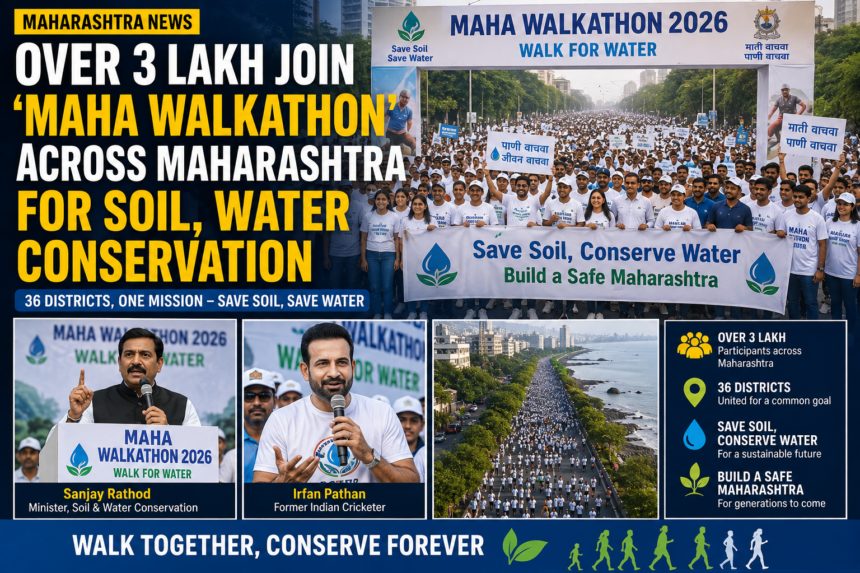
MUMBAI, August 21, 2026: More than three lakh citizens across all 36 districts of Maharashtra participated in the state-wide ‘Maha Walkathon – Walk for Water’ on Friday, turning the campaign into one of the state’s largest public-awareness drives focused on soil and water conservation. The initiative sought to encourage citizens, particularly young people, to take a more active role in protecting natural resources and building a water-secure Maharashtra.
The state-level event was held in Worli, Mumbai, where Maharashtra Soil and Water Conservation Minister Sanjay Rathod addressed participants and emphasised the importance of public involvement in conservation efforts. The programme was organised by the Soil and Water Conservation Department as part of a broader campaign to take the message of environmental protection directly to communities across the state.
‘Save Soil, Conserve Water’ Message
The central message of the initiative was “Save soil, conserve water and build a safe Maharashtra.” Officials said the walkathon was designed not merely as a sporting or fitness event but as a platform to increase awareness about the connection between healthy soil, groundwater availability and long-term agricultural sustainability.
Rathod said soil and water are directly connected to Maharashtra’s future and stressed that government programmes would be more effective when citizens actively participated in conservation. He particularly highlighted the role of the youth in transforming water conservation into a sustained people’s movement.
The campaign was held across all 36 districts, allowing local communities to participate in activities centred around water conservation and responsible use of natural resources. Events were also organised at district level, including a walkathon in Raigad at Alibaug Beach.
Public Figures Join the Campaign
The Mumbai event also attracted prominent personalities from sports, politics and entertainment. Former Indian cricketer Irfan Pathan participated in the walkathon and highlighted the importance of the “Save soil, save water” message.
Pathan said he was pleased to see a large number of people gathering for the cause and stressed that water conservation is an issue whose importance is widely understood. His participation added visibility to the campaign and helped bring the environmental message to a wider audience.
Other personalities who participated included Sachin Ahir, Sanjay Rathod, Jackie Bhagnani and Rajneesh Duggal, according to reports. Their presence further boosted public attention around the initiative.
Linking Soil Conservation With Water Security
Minister of State for Soil and Water Conservation Indranil Naik highlighted another important aspect of the campaign: soil erosion. He explained that rainwater flowing away from land can carry fertile topsoil with it, while also reducing the amount of water that is able to percolate into the ground.
This connection makes soil conservation an important component of Maharashtra’s wider water-security strategy. Measures that slow water runoff, protect fertile soil and improve groundwater recharge can potentially benefit agriculture and rural communities over the long term.
Building a People’s Movement
Deputy Chairman of the Maharashtra Legislative Council Sachin Ahir described the walkathon as an innovative way of taking the conservation message to people at the grassroots level. He stressed that water is a universal necessity and that conservation efforts should reach communities regardless of social or religious differences.
The Maha Walkathon 2026 forms part of Maharashtra’s broader campaign to raise awareness about water conservation. The state had announced August 21 as Water Conservation Day, with awareness activities running during the week leading up to the event and a longer statewide conservation campaign planned from August 15, 2026, to January 26, 2027.
With participation crossing three lakh people, Friday’s walkathon has given Maharashtra’s soil and water conservation campaign a significant public platform, putting the focus on community participation and sustainable management of the state’s natural resources.