Raj Thackeray Responds Strongly to Mohan Bhagwat’s Language Remarks
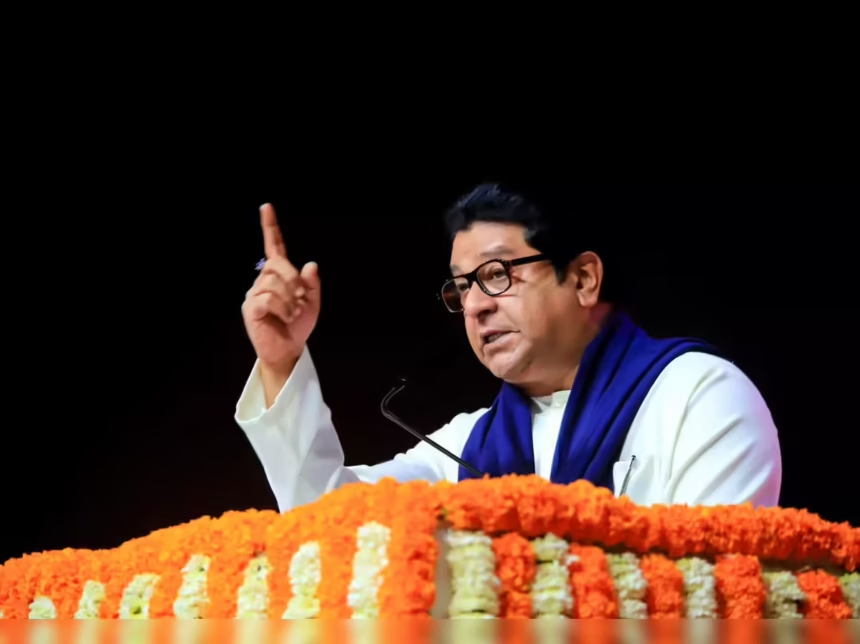
A fresh political debate has emerged after Maharashtra Navnirman Sena chief Raj Thackeray sharply criticized Rashtriya Swayamsevak Sangh chief Mohan Bhagwat over his recent comments on language-based agitations. The exchange has once again brought the sensitive issue of linguistic identity and regional pride into the national spotlight.
Bhagwat had reportedly described insistence on language and related protests as a kind of “disease.” This remark drew immediate reactions from various quarters, but Raj Thackeray’s response has been among the most direct and strongly worded.
Through a series of public statements and social media posts, Thackeray defended linguistic identity while questioning the motivations behind Bhagwat’s remarks.
The Trigger Behind the Controversy
Bhagwat’s comment on language identity
The controversy began after Mohan Bhagwat spoke about language-related agitations, suggesting that excessive insistence on linguistic identity could create divisions. His remarks were interpreted by some political leaders as dismissive of regional pride.
Language has always been an emotionally charged topic in India, where states were reorganized largely on linguistic lines after independence. Many regional political movements continue to center around language preservation and cultural identity.
Why it sparked strong reactions
For leaders like Raj Thackeray, whose political identity has been closely linked with promoting Marathi language and culture, such comments carry deeper implications. He argued that attachment to one’s language is natural and widespread across India, not something unusual or problematic.
Raj Thackeray’s Main Arguments
Claim about attendance at the RSS event
Thackeray suggested that prominent personalities attending Bhagwat’s recent program may not necessarily have done so out of admiration. Instead, he hinted that political influence and the presence of strong central leadership might have played a role.
This claim added a political dimension to what initially seemed like a cultural debate.
Defense of linguistic identity
A key part of Thackeray’s response focused on defending the importance of language and regional pride. He argued that strong linguistic identities exist in many states, including Karnataka, Tamil Nadu, West Bengal, Punjab, Gujarat, and Maharashtra.
According to him, calling such sentiments a “disease” overlooks India’s diverse cultural reality and historical context.
Migration, Culture, and Local Sentiments
Concerns raised by Thackeray
Raj Thackeray also touched upon the issue of migration between states. He argued that when large numbers of people move to another state and fail to respect local language and culture, tensions can arise.
This point reflects a long-standing political issue in Maharashtra, where debates around migration, employment opportunities, and cultural identity frequently surface.
Broader national context
Such discussions are not limited to Maharashtra. Similar concerns have appeared in other states where rapid urbanization and migration have changed social dynamics.
Balancing national integration with regional identity remains a complex challenge for policymakers.
Political Leadership and Regional Pride
Criticism of Maharashtra’s leadership
Thackeray also criticized what he described as weak political leadership in Maharashtra, suggesting this allowed outside voices to dominate debates about language and identity.
He argued that strong leadership would more actively protect regional cultural interests.
Debate over language politics
The language issue often intersects with electoral politics. Leaders sometimes emphasize linguistic identity to mobilize voter support, while others advocate broader national integration.
This tension is part of India’s evolving political landscape.
The Hindi Language Debate
Questioning language imposition
Another important aspect of Thackeray’s remarks involved concerns about the perceived spread of Hindi across different parts of India.
He pointed out that Hindi is not officially designated as the national language, even though it is widely spoken and used in administration.
This argument reflects ongoing debates in several non-Hindi-speaking states, where leaders stress the importance of preserving local languages.
RSS and Politics: A Continuing Debate
Questioning political involvement
Thackeray also questioned whether the RSS, which describes itself as a cultural organization, should comment on politically sensitive issues like language.
While he acknowledged the organization’s work in certain areas, he suggested that public statements on language and identity inevitably carry political implications.
This debate about the role of socio-cultural organizations in political discussions is not new and continues to shape public discourse.
Hindutva and Language Identity
Warning against mixing issues
Another key point raised by Thackeray was the need to keep religious identity debates separate from language issues.
He cautioned that linking Hindutva with language politics could complicate both discussions and create unnecessary tensions.
Emphasis on consistent principles
Thackeray reiterated his party’s stance that it opposes injustice regardless of context, whether related to religious practices, public noise issues, or cultural conflicts.
This position reflects an attempt to frame the party’s approach as consistent rather than selectively political.
Marathi Identity and Political Messaging
Commitment to regional culture
Throughout his response, Thackeray emphasized that protecting Marathi language and culture remains a core priority for his party.
He stressed that linguistic identity is a fundamental aspect of selfhood for many communities and cannot simply be dismissed.
Emotional connection to language
Language is not just a communication tool; it often carries emotional, cultural, and historical significance. For many people, it represents heritage, community, and belonging.
This emotional dimension explains why language debates frequently become politically charged.
Historical Context of Linguistic Identity in India
State reorganization after independence
India reorganized its states largely along linguistic lines in the 1950s to address cultural and administrative concerns.
This decision acknowledged the importance of language in shaping identity and governance.
Continuing relevance today
Even decades later, language continues to influence politics, education policies, media, and cultural movements.
The debate triggered by recent remarks reflects how deeply language remains connected to identity in India.
Public Reaction and Political Impact
Mixed reactions
Public reactions to the controversy have been varied. Some support Bhagwat’s call for unity beyond language divisions, while others agree with Thackeray’s emphasis on preserving regional identity.
Such debates often highlight the diversity of opinions within Indian society.
Possible political consequences
Language-related discussions can influence electoral politics, especially in states where regional identity plays a strong role.
Leaders’ positions on such issues often resonate deeply with local voters.
The Larger Conversation Ahead
The exchange between Raj Thackeray and Mohan Bhagwat is part of a broader national conversation about identity, unity, and cultural diversity.
India’s strength lies in its linguistic and cultural variety, but balancing this diversity with national cohesion requires ongoing dialogue and sensitivity.
As urbanization, migration, and globalization continue to reshape society, these debates are likely to remain relevant.
The recent remarks by Raj Thackeray in response to Mohan Bhagwat have reignited discussions about language, identity, migration, and politics in India.
While opinions differ, one thing is clear: language remains a powerful symbol of cultural pride and personal identity for millions of Indians.
How political leaders navigate this issue will continue to shape public discourse and policy decisions in the years ahead.