BMC Budget to Be Presented Before Elected Corporators After Four-Year Gap
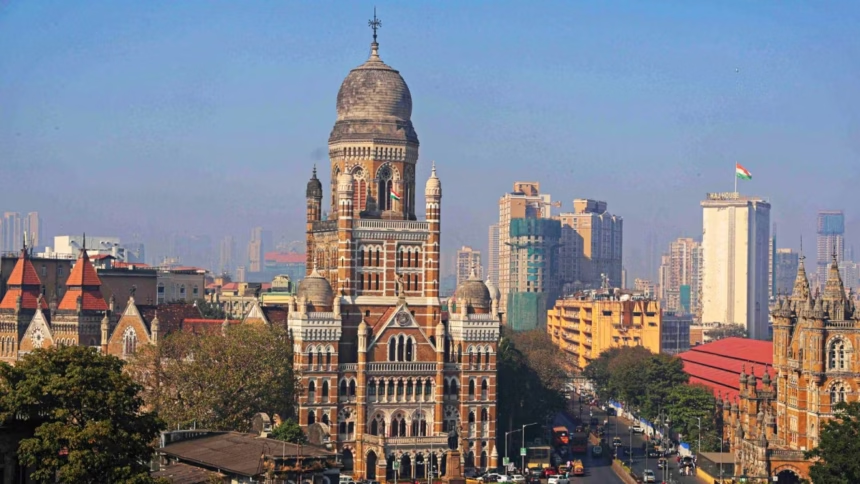
For the first time in four years, Mumbai’s civic budget will be presented in the presence of elected corporators, marking a significant moment in the city’s municipal governance. The Brihanmumbai Municipal Corporation (BMC) is expected to table its annual budget in the second half of February, breaking from the long-standing tradition of presenting it on February 4.
This development follows the long-awaited civic elections, which have restored an elected body to the country’s richest municipal corporation. Until now, the BMC has been functioning under an administrator, with budgets being prepared and presented without direct input from elected representatives.
Why This Budget Is Different From the Last Four Years
Return of Democratic Oversight
The five-year term of the BMC house elected in 2017 ended on March 7, 2022. Since then, the civic body has been run by an administrator appointed by the Maharashtra government. During this period, three annual budgets for 2023, 2024, and 2025 were presented by the municipal commissioner in the absence of corporators.
The upcoming budget will be the first since 2022 to be debated and discussed in front of elected representatives. Civic officials believe this will reintroduce an important layer of democratic feedback that was missing over the last few years.
How Budgets Were Presented Without Corporators
Administrator-Led Financial Planning
In the absence of an elected body, Municipal Commissioner Bhushan Gagrani presented the last three budgets as the administrator of the BMC. While these budgets were legally valid, they lacked the grassroots-level inputs that corporators typically provide.
Senior officials acknowledged that although essential works continued uninterrupted, the absence of elected representatives meant fewer discussions around neighbourhood-specific needs, daily civic issues, and ward-level priorities.
Focus on Mega Infrastructure Projects
Big Spending on Long-Term Development
Over the last four years, the BMC budget has increasingly focused on large-scale, long-term infrastructure projects. These projects are aimed at transforming Mumbai’s basic services and addressing long-standing urban challenges.
Some of the key projects that received major allocations include:
- Sewage Treatment Plants with an investment of around Rs 27,000 crore
- The Mumbai Coastal Road Project
- The final stretch of the Coastal Road between Versova and Dahisar
- The waste-to-energy plant at the Deonar dumping ground
- Road concreting works worth approximately Rs 17,000 crore
- The Goregaon-Mulund Link Road
- Construction and redevelopment of major bridges across the city
These projects account for a large portion of the capital expenditure in recent budgets.
Was Local Infrastructure Ignored?
Officials Defend Budget Priorities
While critics have often accused the administrator-led budgets of overlooking local needs, civic officials argue otherwise. According to a senior official, investments were also made in improving hospitals, schools, and basic civic amenities across Mumbai.
However, the official admitted that the absence of corporators meant there was limited direct feedback from citizens’ representatives. Such feedback often helps identify pressing local issues like drainage problems, road repairs, water supply gaps, and sanitation concerns that may not always feature prominently in large infrastructure plans.
Sharp Rise in Capital Expenditure
From 36 Percent to 58 Percent
One of the most striking changes in the BMC’s financial planning over the past few years is the sharp increase in capital expenditure.
In 2022, when the last elected body was in place, capital expenditure accounted for about 36 percent of the total budget. By 2025, this figure had risen to 58 percent, reflecting a strong focus on asset creation and long-term projects.
This shift indicates a clear policy direction towards building permanent infrastructure rather than spending primarily on routine maintenance and operational costs.
BMC Budget Size Nearly Doubles
From Rs 38,515 Crore to Rs 74,366 Crore
Along with changes in spending priorities, the overall size of the BMC budget has grown dramatically. In 2022, the total budget stood at Rs 38,515 crore. By 2025, it had risen to Rs 74,366 crore, making it one of the largest municipal budgets in Asia.
Officials attribute this increase to a combination of factors, including rising construction costs, ambitious infrastructure plans, and expanded responsibilities of the civic body.
What Corporators Bring Back to the Table
Voice of the Neighbourhoods
With corporators returning to the house, civic officials expect more detailed discussions on local civic issues. Corporators often act as a bridge between citizens and the administration, highlighting everyday problems that may not be captured in top-down planning.
These include issues such as:
- Local road repairs
- Drain cleaning and flooding prevention
- Waste collection and sanitation
- Maintenance of public toilets
- Improvements in municipal schools and clinics
- Ward-level water supply issues
The presence of corporators is expected to bring balance between city-wide infrastructure goals and neighbourhood-level needs.
Possible Changes in Budget Priorities
Will Local Issues Get More Attention?
While big infrastructure projects are likely to remain a priority, the return of an elected body could lead to greater emphasis on smaller, people-centric projects. Corporators may push for increased funding for maintenance, repairs, and upgrades that directly affect daily life.
There may also be more scrutiny of large projects, with questions raised about timelines, costs, and impact on local communities.
Timing of the Budget Presentation
Breaking From February 4 Tradition
Traditionally, the BMC budget has been presented on February 4. This year, however, the civic body is likely to present it in the second half of February.
Officials say the delay is linked to procedural requirements following the formation of the new elected body and the need to align administrative processes with the restored democratic setup.
A Crucial Moment for Mumbai’s Civic Governance
Balancing Vision and Ground Reality
The upcoming budget presentation is being closely watched by citizens, activists, and urban planners. Many see it as an opportunity to recalibrate Mumbai’s development priorities after four years of administrator-led governance.
The challenge for the BMC will be to strike a balance between continuing ambitious infrastructure projects and addressing the everyday civic problems faced by residents across the city.
What to Expect Going Forward
More Debate, More Accountability
With corporators back in the house, budget discussions are expected to be more detailed and, at times, contentious. This could slow down decision-making but may also lead to more inclusive and accountable governance.
Civic officials believe that constructive feedback from elected representatives will ultimately strengthen policy decisions and ensure that public money is spent more effectively.
Final Thoughts
The return of elected corporators to the BMC budget process marks a turning point in Mumbai’s civic administration. After four years of operating without direct democratic oversight, the civic body is set to reintroduce a crucial layer of public representation.
As Mumbai prepares for one of its largest-ever municipal budgets, all eyes will be on how priorities shift, how debates unfold, and whether the new setup can deliver both grand infrastructure and better everyday civic services.