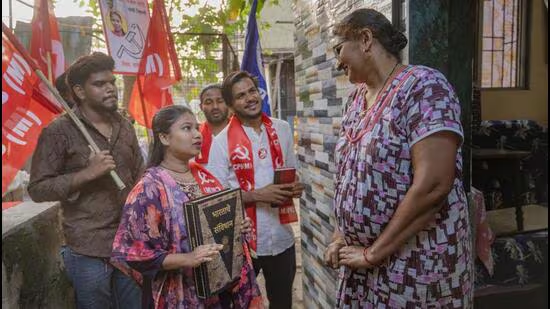
A Young Adivasi Voice Steps Into Mumbai’s Civic Politics
More than a decade after joining protests to protect Mumbai’s Aarey forest, 22-year-old Sejal Bhopi is preparing for another defining battle, this time at the ballot box. Contesting the Brihanmumbai Municipal Corporation elections from Ward No 121, Bhopi believes that saving Aarey is not just about preserving a forest, but about safeguarding Mumbai’s future.
Ward No 121 is the only Scheduled Tribe-reserved women’s seat in the upcoming civic elections and represents nearly 28,000 voters. For many residents, especially Adivasis living on the edge of Aarey, Bhopi’s candidature signals long-awaited representation.
From the Save Aarey Movement to the Election मैदान
A Childhood Shaped by Protest and Purpose
Sejal Bhopi’s association with the Save Aarey Movement began when she was barely a teenager. At a time when most children were focused on school and play, she was attending rallies and learning about environmental justice, displacement, and the rights of indigenous communities.
Over the years, those early experiences shaped her political consciousness. Today, she is contesting the elections as a candidate of the Communist Party of India (Marxist), determined to take grassroots activism into formal governance.
Balancing Struggles, Work, and Activism
A Life Rooted in Reality
Bhopi’s journey has not been easy. She enrolled for a BA degree in rural development but was forced to discontinue her studies in the second year due to financial difficulties. To support herself and her family, she took up work as a salesgirl.
Despite long working hours, she continued to remain active on the ground as part of the Democratic Youth Federation of India, the youth wing of CPI(M). Recently, she resigned from her job to focus fully on the election campaign.
Her decision reflects both personal sacrifice and political commitment, something her supporters often point to as proof of her sincerity.
Inside Ward No 121: Where the Forest Meets the City
A Campaign Office That Reflects Its Candidate
At Gunda Pachal, on the edge of the Aarey forest, a narrow entrance opens into a cluster of chawls. Tucked inside is Bhopi’s modest campaign office, a small tin-roofed room that serves as the nerve centre of her election efforts.
Every day, groups of young supporters gather here before setting out with red flags, mufflers, and energetic slogans. Locals say this style of campaigning has become Bhopi’s signature, direct, vocal, and deeply connected to the community.
A Crowded Contest, A Clear Identity
Ward No 121 has six candidates in the fray. Apart from CPI(M), the contest includes candidates from Shiv Sena, Shiv Sena (UBT), the Vanchit Bahujan Aghadi, and two independents.
Yet, many residents say Bhopi stands out because she is not an outsider parachuted in during election season. She is seen as someone who has lived the issues, protested alongside locals, and understands the daily struggles of Adivasi life in the city.
What Sejal Bhopi Is Fighting For
Core Issues at the Heart of Her Campaign
When asked about her priorities, Bhopi lists environmental protection, Adivasi rights, women’s safety, sanitation, and education as the pillars of her campaign.
She stresses that her work did not begin with the election. According to her, activism on these issues has been ongoing for years, regardless of whether she held any official position.
Her campaign, she says, is also about political education. Many residents, she believes, have been left unaware of what corporators are actually supposed to do. Through door-to-door interactions, she aims to explain accountability, civic responsibilities, and how elected representatives can truly serve people.
Civic Issues That Shape Daily Life
Broken Roads, Water Shortages, and Housing Promises
The problems in Ward No 121 are many and persistent. Residents complain of broken pathways, overflowing drains, irregular garbage collection, and incomplete redevelopment surveys under the Slum Rehabilitation Authority.
Despite being located next to Vihar Lake, one of Mumbai’s major water supply sources, locals face frequent water shortages. For many, this irony has become a symbol of neglect.
Residents say they want a representative who understands these contradictions and can push the civic body to act.
Adivasi Identity and Representation Matter
A Long History of Being Overlooked
For Adivasi voters, Bhopi’s candidature carries emotional weight. Jayesh Nikule, a resident of Ultan Pada, explains that despite their significant population, Adivasis have often been sidelined by mainstream parties.
The reservation of the ward for Scheduled Tribe women has created an opportunity for meaningful representation. According to locals, having a representative from within the community makes it easier to raise issues like caste certificates, land rights, and livelihood concerns.
Many feel that an outsider can never fully grasp the complexities of Adivasi identity and survival in a rapidly urbanising city.
Youth Support Grows on the Ground
A Candidate Who Speaks Their Language
The youth of areas like Morarji Nagar have taken a keen interest in Bhopi’s campaign. Photographer Jairaj Nadar, 26, says young people are often mobilised during elections but forgotten afterward.
For many first-time and young voters, Bhopi represents something different. She is close to their age, speaks directly to their concerns, and is seen as a genuine voice rather than a symbolic one.
Saving Aarey Is Saving Mumbai
A Bigger Vision Beyond the Ward
Bhopi repeatedly connects local struggles to city-wide consequences. According to her, the fight to save Aarey is fundamentally about Mumbai’s ecological survival.
She recalls how activists had warned years ago that destroying green cover would worsen heatwaves, intensify flooding during monsoons, and make urban life more difficult. Today, she believes those warnings are becoming reality.
For her, protecting Aarey is not just an environmental issue but a civic responsibility that affects climate resilience, water security, and quality of life across Mumbai.
A Quiet Yet Powerful Political Statement
As election day approaches, Sejal Bhopi’s campaign is drawing attention not because of flashy promises, but because of its grounded nature. Her story reflects a blend of activism, lived experience, and a belief that real change begins at the local level.
Whether she wins or not, many believe her presence in the race has already reshaped conversations around youth leadership, Adivasi representation, and environmental responsibility in Mumbai.
For Bhopi, the message remains simple yet powerful: saving Aarey means saving Mumbai, and that fight begins with giving a voice to those who have protected it all along.