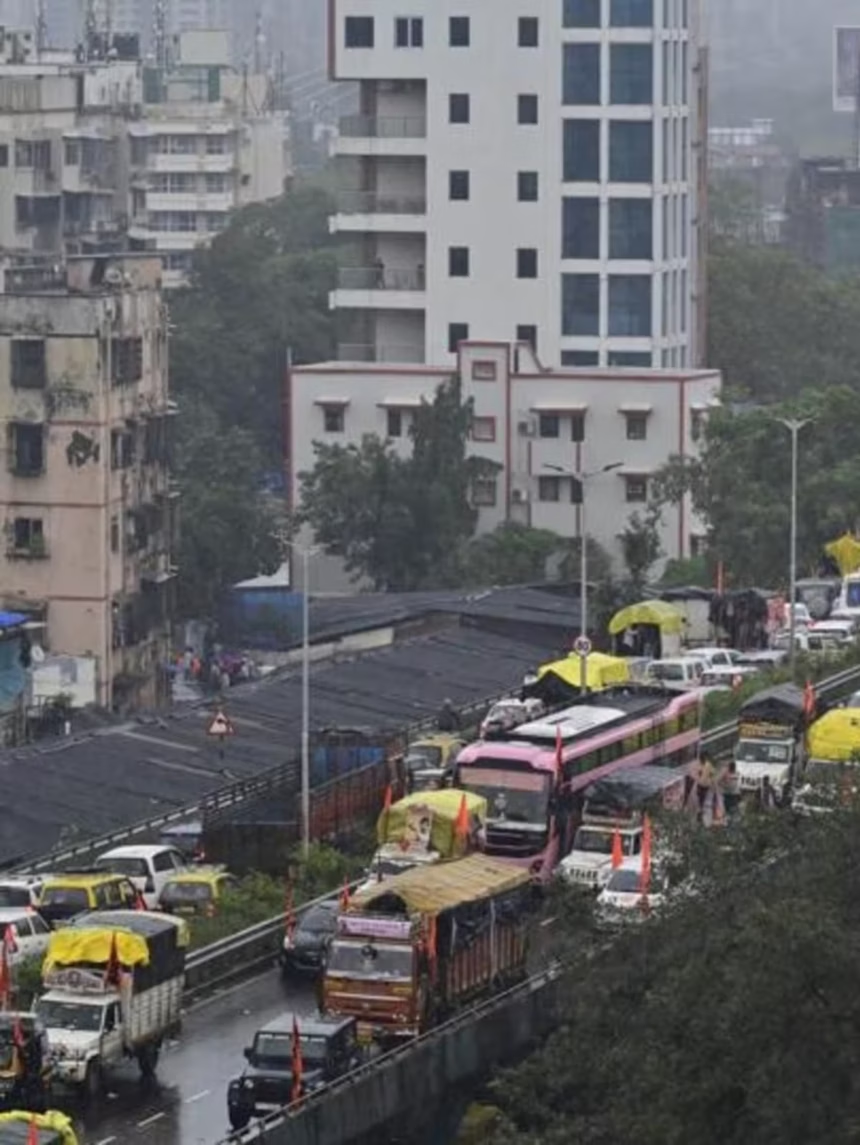
Thane, one of the fastest-growing urban districts of Maharashtra, is in the midst of a severe traffic crisis that has blown up into a daily struggle with each passing day. Once thought of as a quieter alternative to Mumbai, Thane has rapidly grown into a major residential and commercial hub — but its road infrastructure has failed to keep pace with the same rapid expansion. The result is a chronic traffic jam problem now spilling over into many adjacent parts of Mumbai, causing delays throughout, fuel wastage, and frustration among commuters.
In spite of several interventions over the years, the situation continues to worsen, with urban planners and citizens’ groups describing Thane’s traffic as “reaching an unmanageable level.”
Vehicle population surging, roads not scaling
One of the fundamental reasons for Thane’s deteriorating traffic is the growing mismatch between the number of vehicles and the capacity of the current road network. As per municipal data, Thane’s vehicle population has almost quadrupled in the last decade, with new car registrations reaching all-time highs every year.
However, the road network, barely 350 km long, has not grown in proportion to the growth of the city. Large parts of Thane still have narrow, decades-old roads that cannot cope with the present-day traffic volume. Areas such as Ghodbunder Road, Eastern Express Highway exits, Wagle Estate, and Naupada receive a high volume of traffic during peak hours.
This imbalance causes bottlenecks throughout the day and will turn what should be short commutes into hour-long gridlocks.
Illegal Parking, Encroachments Worsening the Problem
Illegal roadside parking has become a silent aggravator of the crisis. In places like Majiwada, Teen Hath Naka, and Panchpakhadi, for instance, parked vehicles occupy between 20% to 40% of road space at peak hours. Similarly, hawker encroachments and construction-related blockages reduce the effective width of roads even further.
Moreover, various unauthorized structures and informal settlements make expansion projects extremely difficult. The authorities have started periodic crackdowns and clearing drives; however, the improvements seldom last.
Infrastructure Projects Causing Additional Throttles
While Thane is seeing a number of major infrastructure upgrades—metros, flyovers, and road-widening—the construction activity has ironically added to the congestion. Key choke points include:
Ongoing work on Metro Line 4 and 5
Construction on Kapurbawdi–Ghodbunder stretch
Upgrading of major junctions including Cadbury, Teen Hath Naka, and Balkum
Pothole repair works during monsoon
Construction seals the lanes, and the flow of vehicles slows down to a crawl, with congestion spilling into connecting roads leading to Mumbai and Navi Mumbai.
Spillover into Greater Mumbai: The Growing Concern
Perhaps the most worrying trend, however, is the spillover of Thane traffic into Mumbai, especially along arterial routes.
- Eastern Express Highway (EEH)
Peak-hour backups from Thane often spill into Mumbai suburbs like Mulund, Ghatkopar, and Vikhroli, making travel times unpredictable.
- LBS Marg
Resultantly, the Thane–Mulund–Bhandup belt has now emerged as one of the city’s slowest-moving corridors, with traffic sometimes building up for several kilometers.
- Ghodbunder Road to Western Suburbs
The tailback is jammed with motorists commuting to Borivali and further ahead because congestion keeps feeding in from Thane.
Delays, even in internal areas, are increasingly reported by Mumbai residents, who blame them on the overflow of Thane’s traffic load.
Experts Warn of an Impending Breakdown
Urban mobility experts say that Thane may be reaching a critical point of saturation. A mismatch between rapid residential development—especially high-rise clusters—and lagging civic planning is pushing the system to its limits.
Some key warnings include:
Average vehicle speeds during peak hours falling below 10 km/h
Increased air pollution due to idling vehicles
High stress and loss of productivity among commuters
Increased risk of accidents at congested junctions
They say that without immediate large-scale interventions, the traffic crisis in Thane could become one of the worst in India’s metropolitan areas.
Solutions possibly in the offing
Authorities are exploring various ways of tackling the crisis:
Completion of Metro Line 4 and Line 5, expected to drastically reduce road dependence.
Dedicated freight corridors to divert heavy vehicles
ITMS for better signal coordination.
Expansion of key arterial roads and construction of new connectors
Multi-level parking facilities to curb illegal parking
Encroachment-free zones around major junctions
TMC and MMRDA are also considering a long-term plan for new arterial links that will help distribute the traffic at all junctions.
A City At A Crossroads Thane stands at a critical juncture. Its growth story has been impressive, but the burden of inadequate planning now threatens its livability. As the spillover continues to choke greater Mumbai, the urgency for well-coordinated, high-impact solutions has never been greater. The overcoming of Thane’s traffic nightmare will depend on the pace of upcoming infrastructure projects, whether rules are consistently enforced, and the willingness of authorities to adopt a pedestrian- and transit-first vision for the future.