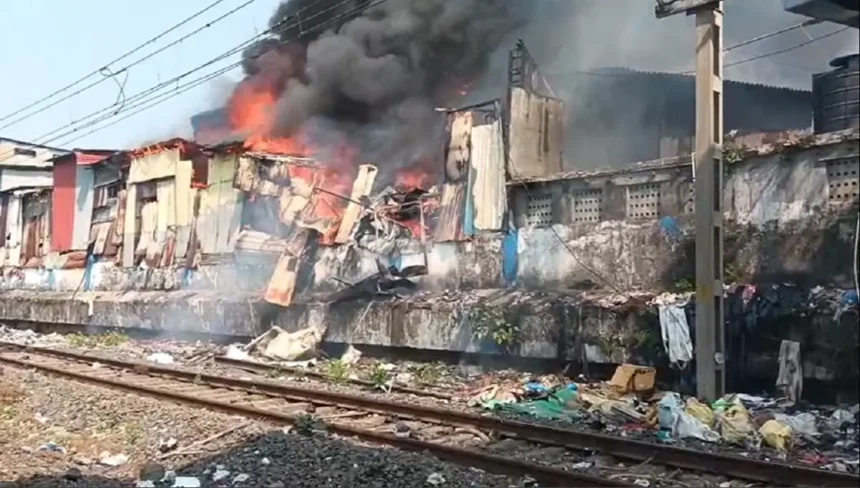
A major fire broke out in Mumbai’s Dharavi area on Saturday afternoon, triggering disruptions across the city’s railway network and bringing the spotlight once again to the vulnerability of densely populated urban settlements. The incident, which was reported near the Harbour Line railway tracks between Mahim and Bandra, led to the suspension and regulation of services temporarily, inconveniencing thousands of commuters during peak travel hours.
Incident: Fire near the Tracks
The fire broke out around 12:29 pm in the Navrang Compound near Mahim Fatak, an area marked by congested homes, small-scale industrial units, and a labyrinth of narrow lanes. Quick to act, Mumbai Fire Brigade officials classified the fire as Level-II, thus mobilizing an efficient response involving multiple departments into action.
Thick plumes of smoke were visible rising from the densely populated locality, with the fumes drifting towards the railway tracks and overheard electric equipment. Because the fire was very close to the tracks, the Western Railway immediately deployed an emergency plan, suspending and diverting several Harbour Line trains.
Preliminary reports showed no casualties, though the loss of property and structural damage within the compound are being assessed. The exact cause of the fire is still under investigation, but residents reported hearing minor explosions—probably caused by gas cylinders—in the early moments of the incident.
Impact on Train Services
The suburban railway network in Mumbai is the lifeline of the city, ferrying more than 70 lakh commuters daily. Even minor disruption triggers a cascading effect on the network, and Saturday’s fire was no exception.
The immediate casualty was the Harbour Line, which links CSMT with Panvel and also serves vital exchanges at Wadala Road, Mahim, and Bandra. Services between Mahim and Bandra remained suspended for several hours as fire and railway teams assessed the risk posed by the flames to overhead wires, signalling units, and station infrastructure.
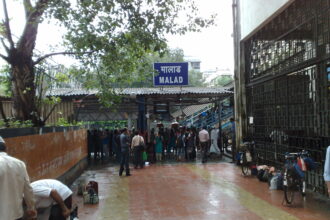
Several trains were diverted to other tracks, while others were stuck at a certain point en route. There were reports of substantial delays as hundreds of commuters remained stranded at Wadala, Vadala Road, Kurla, and Bandra. The Western Railway worked in tandem with the Fire Brigade and the Mumbai Police to not allow any train in the danger area.
Quick Response by Agencies
The situation was contained before it got worse due to the concerted effort of the Mumbai Fire Brigade, Western Railway, BMC, and Mumbai Police. The fire fighters deployed multiple water jets to douse the fire, while the electrical teams began inspecting the overhead equipment for safety before restoring the services.
The local residents-mostly living in informal settlements-assisted authorities in clearing access lanes and helped relocate the most vulnerable residents away from the site. Despite the structural challenges brought about by the dense layout of Dharavi, the fire was brought under control within a few hours.
Railway engineers conducted rigorous on-ground inspections before allowing phased resumption of services. While some Harbour Line trains resumed shortly after the containment, full normalcy was restored later in the evening.
Human Stories from the Ground
Street vendors, daily wage workers, and residents spoke of chaotic scenes as the smoke spread in the locality. Many rushed to salvage belongings, while others evacuated their homes fearing the fire would spread rapidly through the tightly packed neighborhood.
For commuters, the disruption added to their day’s stress. With delays expected, college students, office-goers, and travellers heading to Mumbai’s airports faced inconvenience, forcing most of them to take to the roads and adding to congestion at the Mahim–Bandra belt.
Recurring Urban Challenge
Incidents like this underline the chronic fire hazards in Mumbai’s thickly populated informal settlements. Dharavi is one of the largest slums in Asia, where congested structures, narrow passages, and widespread use of flammable material make it highly susceptible.
Urban planners have been demanding better fire-safety measures, periodic structural audits, and better access routes for emergency vehicles for long. Though small fires do occur in the locality quite frequently, the vicinity of Saturday’s incident to a major railway corridor escalated the scale of disruption and also highlighted how interlinked the infrastructure networks of Mumbai function.
Looking Ahead Authorities are likely to undertake a thorough investigation into the cause of the fire and assess various measures for prevention, in order to prevent recurrence of such incidents near key transport corridors. The Western Railway may also examine safety protocols, including surveillance and real-time monitoring of high-risk zones along its network. For now, the swift action of emergency responders ensured the fire was contained with minimal human harm. Yet, the incident serves as a stark reminder of how fragile dense urban ecosystems can be—and how quickly disruptions in one part of the city can ripple across Mumbai’s daily life.