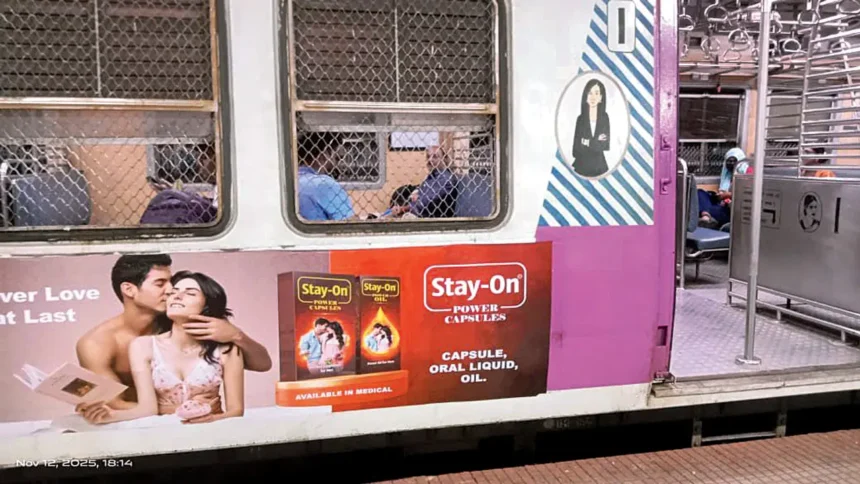
In a comprehensive crackdown on fraudulent advertisement and public deception, the Mumbai Railway Police arrested five persons linked to a big operation that plastered thousands of misleading posters across the city’s vast suburban train network. Illegal posters promising services from “love marriage solutions” and “Mohini Vashikaran” to fake property deals, job guarantees, and miracle remedies had become increasingly visible inside local trains, on station walls, and across foot-overbridges over the past few months, triggering widespread concern among commuters.
Authorities estimate that the gang may have put up nearly 60,000 posters, making it one of the biggest poster-related fraud operations unearthed in recent times. The arrests came after a detailed investigation that was initiated after several passengers and railway officials complained about suspicious advertisements promising unrealistic services with unknown mobile numbers. Many of these posters were found in high-footfall areas like Dadar, Kurla, Andheri, Churchgate, CSMT, and Thane.
According to the police, the accused had been working in a highly organized manner. They divided the railway network amongst themselves and selectively targeted trains during non-peak hours, usually late night or early morning, to avoid detection by on-duty security personnel. Fragments of their movements were captured on CCTV cameras. Careful scrutiny of footage obtained from several stations helped the authorities follow their movement trail. After tracking them for nearly a week, special teams conducted synchronized raids across Kurla, Mankhurd, and Govandi and arrested them.
The investigators later found out that these posters were not merely eyesores but an actual trap created to lure unsuspecting persons. Many of the numbers were presented as helplines for problems such as relationship issues, marital disputes, job problems, or affordable property deals. Those who contacted the numbers were routed to operators at the other end who introduced themselves as astrologers, consultants, or agents. Victims complained of being forced to pay an advance fee towards conducting “rituals,” “document processing fees,” or “booking amounts” only to find that it was a fraud.
According to a senior Railway Police officer, the gang’s activities were part of the broader scam ecosystem. “These posters were not random. They were carefully crafted to attract emotionally distressed or financially struggling people. Once someone called, the scammers used psychological tactics and false promises to extract money. These are dangerous networks that ruin people financially and emotionally,” he said.
Authorities also pointed out that illegal posters create operational hazards for the railways. They cover official signage, emergency instructions, and safety information, leading potentially to confusion during urgent situations. Additionally, they degrade public property and contribute to the visual littering of one of the world’s busiest suburban rail systems.
The arrests have come as a welcome relief to commuters in the area who had long complained about the problem. “Almost every train compartment is filled with these ads—love guru, black magic, cheap loans, you name it. Everyone knows they’re fake, but some people fall for them. It’s good that the police have finally taken a strong step,” said Smita Deshmukh, a daily passenger from Borivali.
However, Railway Police view the five arrested as merely field-level operatives and not the masterminds. Preliminary interrogation reveals a larger syndicate is involved in designing the posters, generating the scam phone numbers, and then distributing stacks of printed material to smaller groups across the city. Officers are now working with telecom providers to block fraudulent numbers and trace the identities of those who registered them.
As part of corrective action, cleaning teams have already started removing the posters from inside trains and station premises. The Central and Western Railway administrations are also planning to increase surveillance by expanding CCTV coverage, increasing night-time patrolling, and enforcing stiffer penalties on repeated offenses. Some officials have suggested using tamper-proof surfaces in frequently targeted areas to prevent the adhesion of posters. The police have urged the public to be cautious and avoid calling numbers displayed on suspicious ads offering unrealistic promises. Commuters are also encouraged to report fraudulent posters via the railway helpline or through the Rail Madad app. The mass arrests are a big step in Mumbai’s ongoing efforts to curb scams that target the citizens of the city through public spaces. While the crackdown has weakened one such network, authorities are determined to dismantle the larger ecosystem behind these fraudulent operations, ensuring that Mumbai’s railway environment remains safe, orderly, and free from deceptive influences for its millions of daily commuters.