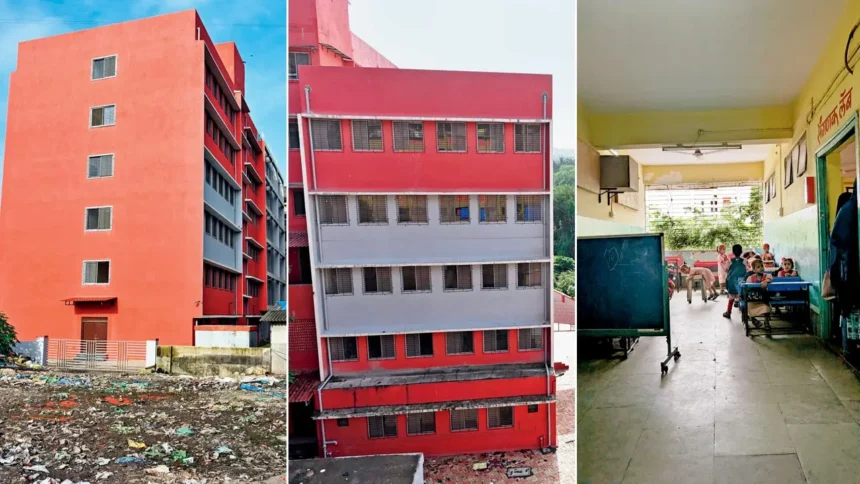
A newly built CBSE school premises in Govandi, Mumbai, has become a focal point of growing frustration among parents and students for not being utilized for over a year now owing to the absence of an approach road. The situation led to a large protest outside the premises this week where nearly 600 parents and students had gathered to demand immediate action from authorities. Their message was clear: the right to education should not be obstructed by administrative delays and infrastructural negligence.
The School building, constructed at considerable public cost, was meant to introduce modern educational facilities and relieve the pressure of overcrowding in schools in the surrounding areas. However, although the construction work of the building was completed in 2023, students were not allowed to enter as the access road from the school to the main stretch, which had been promised, remains unbuilt. The building stands in isolation surrounded by uneven land and internal pathways that are unsafe and inaccessible, particularly during the monsoon season.
Parents say that despite repeated representations to the municipal and district education officials, nothing significant has been done to construct the road. “We have a building with labs, classrooms, and everything ready. Yet, our children are studying in cramped rooms elsewhere. How is this acceptable?” said Ayesha Khan, one of the protesting parents. She termed it “institutional negligence that directly harms children’s futures.”
Most of the families living in Govandi belong to low-income groups, and access to quality education at an affordable rate is very important for their children. The new building of the school was designed to house students from class 1 to 10, easing the pressure off the nearby schools that currently accommodate multiple classes in shared or temporary spaces. Since it is kept locked and unused, students have to continue attending sessions in overcrowded classrooms; some children sit on the floors due to a lack of furniture.
Student voices brought in a poignant dimension to the protest. “We have to walk a long distance to reach our present school, and even when we get to school, there is no space to sit,” said 12-year-old Saniya, holding aloft a placard that asked authorities to “Open Our School.” Several of the students described the disappointment they experience every day in passing by the new campus, knowing that for them it is forbidden territory.
While local officials agree that the situation is dire, they have blamed delayed administrative clearances and disputes over the land for the delay in road construction. The senior municipal engineer said the land designated for the access road needed further surveys and clearances from various planning departments. “We are working to resolve the issue. Once approvals are finalized, road work will begin,” he said. But he did not give a specific timeline, which infuriated parents even more.
Education activists say such delays reflect deeper governance issues in rapidly growing city neighbourhoods. “Infrastructure cannot be treated as an afterthought. If a school was planned and built, the access road should have been part of the project from the beginning,” said activist Ramesh Salve, who has been following the matter closely. He pointed out that similar issues have occurred in other expanding suburbs, where facilities are constructed first and connectivity is addressed later, leading to avoidable delays and resource wastage.
The protest has also stirred a conversation on accountability: calls for an official investigation into why the school was allowed to be finished without ensuring basic accessibility; demands by some community leaders for clear deadlines and a publicly trackable progress report on road construction.
The emotional tone was both one of frustration and determination. This rally was unlike political demonstrations because it drew strength from an issue so very personal: children’s education. The presence of schoolchildren carrying hand-drawn posters and chanting slogans acted powerfully to remind the audience that development gaps affect lives and futures. As the protest gained attention, local representatives assured families that they would raise the issue with higher authorities.
However, parents have declared they will continue their demonstrations weekly until concrete progress is visible. “We are not asking for something new,” said parent leader Imran Shaikh. “We are only asking for our children to use the school that already exists.” A critical lesson of Govandi is that infrastructure projects, to be complete, must have both structure and access. Without connectivity, well-built educational institutions cannot fulfill their purpose. And for the children who line up outside the locked building every morning, the hope remains that the road to their school could someday be more than just a promise.