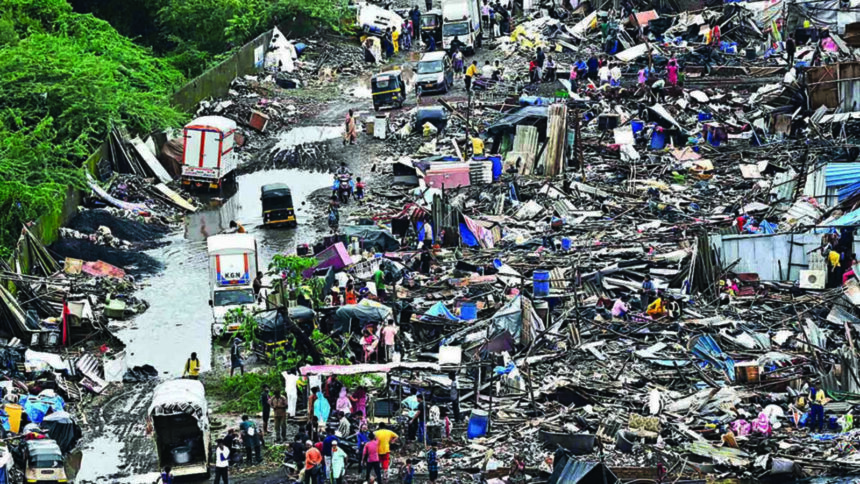
The authorities demolished 135 illegal slum structures in the Malvani area of Malad, a major operation to address the encroachments on public land in Mumbai. The operation, led by the Suburban Collector’s Office and with support from the BMC and local law enforcement, took place on Monday and marked one of the largest recent anti-encroachment drives in the city’s western suburbs.
According to official reports, the razed structures included 127 units at Ali Talao and six others at Chikuwadi, besides two temporary encroachments. The structures had come up on government land without any permission and were not in compliance with development and safety norms. The demolition marked part of a larger drive by the BMC and the Collector’s office to reclaim public land that had been encroached upon over many years, sometimes by the residents and small businesses in one of the city’s most densely populated areas.
An Issue Ongoing in Malvani
Malvani, a locality of western suburbs of Mumbai, has all along been the closest place for unplanned settlements and illicit constructions. The area has witnessed a growth in informal housing made without permission, amid the rapid urbanization of the city and increased housing prices. Many residents live in structures with minimum facilities and safety clearances, which are often threatened by evictions anytime demolition drives are initiated by the authorities.
Officials said it was necessary to prevent further illegal occupation and to ensure proper land use and safety compliance. “These structures were constructed without any permissions, posing risks to the occupants and the environment,” said an officer from the Suburban Collector’s office. “The government is committed to enforcing urban land regulations and ensuring that public land is used for approved and sustainable purposes.”
Residents’ Concerns and Rehabilitation
The action went on smoothly, with heavy police deployment to prevent resistance, but it once again sparked a debate over rehabilitation and affordable housing in Mumbai. Several families who lived in the demolished patches claimed that they had nowhere else to go and that they were not given prior notice or adequate relocation options.
Local activists and NGOs have called upon the government to address the humanitarian side of such operations. “Urban development cannot be achieved by simply razing homes,” a member of a local housing rights group explained. “The authorities must ensure that displaced residents are offered proper rehabilitation and compensation, especially those who have been living there for decades.”
The Maharashtra government has long promised to relocate residents of informal settlements in affordable housing schemes under its SRA policy. However, its implementation has remained slow, and coordination between the BMC and housing boards is sometimes irregular.
The City’s Drive toward Urban Order
Officials have reiterated that the demolition drive is part of a bigger strategy aimed at restoring order and sanity in Mumbai’s city planning. The city has been grappling with the menace of unregulated construction and the resultant clogging of drainage systems, congestion of roads, and incidence of safety hazards.
The civic body has been conducting similar drives in other parts of the city, such as Dahisar, Kurla, and Govandi, against residential and commercial encroachments on government and reserved lands.
While the experts maintain that enforcement is essential, the long-term solution must be in the realms of planned housing, affordable rent, and strict surveillance of land development. According to Shweta Naik, an urban planner, “Clearing illegal structures is a short-term measure. Unless the city provides viable low-cost housing and tightens its building approval process, the problem will resurface in different forms.”
A Balancing Act Between Enforcement and Welfare
The Malvani demolition has restarted debate on the balance between development and social welfare. While civic authorities feel that removing encroachments is necessary to ensure civic order and public infrastructure protection, the residents who were evicted are rendered homeless, jobless, and socially displaced. As Mumbai grows, incidents like these point to the need for comprehensive urban planning, with a mix of legal enforcement and inclusive housing policies. Until such a balance is achieved, the specter of eviction and resettlement will keep haunting both the government and the citizens of this city. The Malvani demolition thus stands as much more than a legal action, serving as a reminder of Mumbai’s constant battle to balance the rapid development of the city with the rights and realities of its most vulnerable residents.