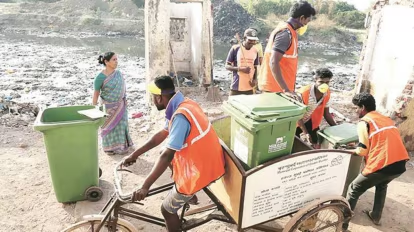
The BMC has declared an all-out war against unsanitary and unruly public behavior in the city, increasing fines for spitting, littering, urinating in public, and defacing walls. This comes in the wake of the civic body’s fresh drive to make Mumbai cleaner, more disciplined, and globally presentable, with the city continuing to grow as India’s economic and cultural capital.
The new policy, following a recent civic review, aims to deter behaviours that contribute to both public nuisance and poor hygiene. Under the new policy, offenders could be facing substantially higher fines, and enforcement officers would be given expanded authority to penalize offenders on the spot.
A Long-Standing Problem Gets Stricter Rules
Civic hygiene has long been a problem that Mumbai seems to be struggling with, from littered streets and overflowing garbage bins to spit-stained walls and roads. While earlier drives and awareness campaigns managed to usher in some improvement, authorities feel that only stronger penalties will bring lasting behavioral change.
Fines for several offences have now been doubled or tripled, BMC officials said. Spitting on roads or walls, for instance, will attract a fine of ₹200 instead of ₹100, while urinating in public spaces will cost offenders ₹500. Littering, pasting posters without permission or dumping construction debris at public places can invite penalties of up to ₹5,000 depending upon the scale of violation.
“These are not just hygiene issues; they directly affect public health and the city’s image,” said a senior BMC official. “Mumbai is an international city that deserves international standards of cleanliness. To achieve that, citizens need to take responsibility for their actions.”
Enforcement: BMC Marshals Back on the Streets
To ensure strict enforcement, BMC marshals, once seen patrolling the markets, railway stations, and busy streets, are being reintroduced across all 24 municipal wards. Marshals will be authorized to issue fines and record offences digitally, sending daily reports on civic compliance.
The civic body has also integrated digital monitoring through the “MyBMC” mobile app, where citizens can report violations anonymously. Geo-tagged complaints can be directly sent to the respective ward offices for immediate action.
Officials have also warned that habitual offenders may face escalated penalties or community service requirements. In some cases, names of repeat violators could even be made public, serving as a deterrent to others.
Citizen Reactions: Support and Skepticism
The new measures have generated mixed reactions among the residents of Mumbai. Many citizens have welcomed the move, terming it a necessary step for the reinstatement of civic discipline. “It’s about time the authorities got strict,” said Rajesh Mehta, a resident of Dadar. “Every morning you see people spitting on the streets or throwing wrappers from moving vehicles. Fines are the only language some people understand.”
Others, however, have questioned the consistency in implementation. “Such drives begin with a lot of fanfare but fizzle out after a couple of weeks,” said a social activist from Andheri. “Unless the BMC sustains this momentum and checks corruption among field officers, the results may be short-lived.”
Public health experts have, on the other hand, welcomed the move, adding that controlling such behaviors has direct benefits in the prevention of tuberculosis, dengue, and gastroenteritis diseases that can only spread within filthy environments.
Overview The greater vision: Clean Mumbai, Smart Mumbai
The tightening of fines thus falls in line with the larger objectives of Swachh Bharat Abhiyan and the “Clean Mumbai, Green Mumbai” initiative. The BMC has also engaged in the enhancement of solid waste management through increased waste segregation, encouragement of recycling, and collaboration with housing societies in adopting zero-waste models.
To supplement the fines, BMC intends to build more public toilets, deploy mobile sanitation units in congested spots, and start awareness drives through schools and societies in the area. The civic body’s officials maintain that penalties along with infrastructure improvement can effect lasting behavioral change.
“Cleanliness is not just about fines; it’s a matter of culture,” said Additional Municipal Commissioner Sudhakar Shinde. “We want citizens to take pride in their city and understand that cleanliness begins with individual responsibility.”
Challenges Ahead
While ambitious, the challenge ahead remains paramount. Monitoring is difficult in a heavily populated city like Mumbai, particularly with heavy footfall and urban sprawl. In several informal settlements, access to public toilets and waste disposal is minimal amid concerns that punitive fines may fall disproportionately on low-income residents.
The BMC, therefore, has announced that fines will be imposed only in certain areas and gradually so that the citizens get time to adapt and increase compliance. For this, civic NGOs will be asked to lead an awareness campaign and facilitate local clean-up drives.
Conclusion Though at this point largely symbolic, BMC’s decision to increase the fines for public disorder and unhygienic behavior sends a strong statement of intent-one that reflects Mumbai’s desire to modernize not just its infrastructure but also its civic consciousness. While enforcement and consistency hold the key to success, this initiative signals a clear shift toward a cleaner, healthier, more disciplined city. If the campaign succeeds, Mumbai can then lead the way for other Indian metros, which face similar problems, to show that cleanliness is not only a duty of the government but also a collective civic responsibility.