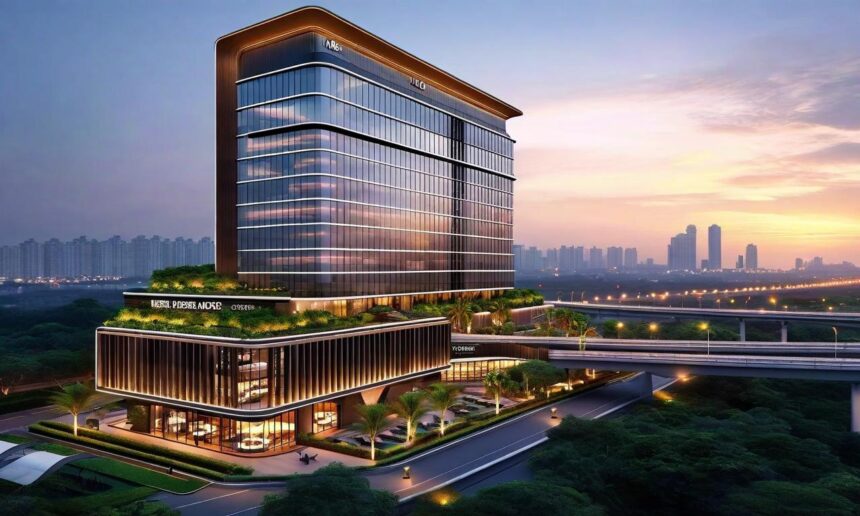
Navi Mumbai — The hospitality sector of India’s economic capital is in for a dramatic change as SAMHI Hotels Ltd, India’s premier hotel ownership and management platform, announced a big-ticket dual-branded hotel project adjacent to the Navi Mumbai International Airport (NMIA). The MIDC has given the project an official extension approval, a key milestone in the city’s changing infrastructure and growth story of tourism.
The proposed project will feature approximately 700 rooms upon completion, making it SAMHI’s largest single hotel asset to date. The property will be dual-branded, operating under Westin (upper-upscale) and Fairfield by Marriott (upper-midscale) brands, subject to final management agreements with Marriott International. This marks a significant expansion for SAMHI, which already operates a strong portfolio of business and leisure hotels across India.
The project is strategically situated in proximity to the new Navi Mumbai International Airport, a globally sized flying hub set to open operations in phases beginning 2026. The project is also favored with adjacent infrastructure like the Mumbai Trans Harbour Link (MTHL), Mumbai–Pune Expressway, and the D.Y. Patil Stadium, thus becoming an aviation, corporate, MICE (meetings, incentives, conferences, and exhibitions), and leisure traveler hub.
The initial phase of the project will have approximately 400 rooms, serving predominantly business and airport transit travelers, according to the management of SAMHI. The capacity will be developed in later phases once the NMIA is fully operational and the hospitality market in the surrounding areas matures.
This project is our vision to create a long-term presence in gateway markets that are proving to have robust infrastructure-driven growth,” explained Ashish Jakhanwala, Managing Director and CEO of SAMHI Hotels. “The development of Navi Mumbai into a global business district makes it an obvious choice for high-end, large-scale hospitality development.
The MIDC extension approval gives SAMHI the extended time and regulatory certainty required to finish the project, ensuring synchronisation with changing airport schedules and city infrastructure development plans. The company further assured that it would implement sustainability and green-building protocols, as per the worldwide trend towards ecologically friendly hospitality.
Corporate and tourism decentralization from the established hubs of South Mumbai and Bandra-Kurla Complex (BKC) to Navi Mumbai is considered to be a wider trend by industry players. The new airport, planned SEZs, and technology parks in Panvel and Ulwe will generate a major business travel drive, while improved connectivity will promote domestic and international tourism.
The Navi Mumbai International Airport will be a game-changer for the hospitality sector,” said Vineet Gupta, a hospitality consultant at HVS India. “Once the airport is up and running, we expect 40–50% of extra demand for hotels in the area, with average room rates and occupancy levels similar to central Mumbai.
The announcement also dovetails with Maharashtra’s tourism expansion plan, which seeks to attract ₹10,000 crore in hospitality investments over the next five years. Government officials have welcomed SAMHI’s move, citing it as an indicator of investor confidence in Navi Mumbai’s growth potential.
The project reinforces our vision to transform Navi Mumbai into a business destination but also a lifestyle and tourism destination,” a senior official of MIDC said. “Large-scale hospitality investment like this will generate thousands of jobs and boost the city’s international competitiveness.
But specialists note that implementation risks still exist. Major hotel developments tend to be delayed on account of regulatory clearances, funding difficulties, and changes in market conditions. The success of the undertaking of SAMHI will be contingent on timely completion, strong brand management, and efficient integration into the airport ecosystem when operational.
Beyond SAMHI’s project, other hospitality players such as Taj, Lemon Tree, and Radisson are reportedly exploring new developments in the Navi Mumbai region. Together, these projects signal the area’s rapid emergence as the next big hospitality hub after Aerocity in Delhi and GIFT City in Gujarat.
For domestic businesses and tourists alike, the effect can be revolutionary. The scheme will introduce new restaurants, party spaces, and retail centers, further establishing Navi Mumbai as a dynamic extension of the Mumbai Metropolitan Region.
As construction gears up, the SAMHI dual-branded hotel is more than just an expansion—it’s a reflection of Navi Mumbai’s ascent as a global gateway. With the convergence of infrastructure, investment, and innovation, the region stands poised to redefine India’s urban and hospitality future.