Mumbai, Oct 27, 2025 — In a historic step toward more fiscal responsibility and formalization of informal enterprises, the Brihanmumbai Municipal Corporation (BMC) has located almost 8,000 commercial establishments within slums spread across Mumbai and sent property-tax bills worth around ₹21 crore. It is a part of a massive civic attempt to legalize the city’s huge unorganized commercial economy, finally bringing accountability to thousands of small enterprises that have been running outside the tax net.
For decades, many of Mumbai’s thriving slum-based enterprises — from tailoring workshops and storage units to small eateries and repair shops — have operated in the shadows of the formal economy. While these establishments play a significant role in supporting local livelihoods and contributing to the city’s economic activity, they have often remained outside the civic revenue system. The BMC’s action marks the beginning of formalizing such units so that all commercial establishments availing themselves of civic facilities pay their due share of taxes.
As per officials, the municipal corporation previously surveyed approximately 17,000 commercial units run by slums and estimated potential tax collection of over ₹600 crore. Yet, because of documentation problems, unregistered ownership of properties, and opposition from unit owners, the recoveries were limited. The ongoing round of billing covering around 8,000 confirmed commercial areas is the most tangible enforcement round up till now.
The Western suburbs of Andheri, Vile Parle, and Bandra have provided the maximum contribution to this collection drive with more than ₹12 crore of the overall ₹21 crore. The areas charge superior ready reckoner rates — the government’s standard measure for valuation of property — indicating superior commercial potential. Compared to the western suburbs, the eastern suburbs, in spite of having more units, pulled in fewer revenues because of lower valuation rates and smaller business establishments.
Authorities made it clear that even as tax collection from these regions will increase civic coffers, it doesn’t legalize the structures in the process. “Property tax is a service-based charge, not a regularization policy,” a senior BMC revenue officer explained. Even if a unit is illegally or unapproved, if it exists and is utilizing civic infrastructure like roads, water or waste services, it has to pay tax.” The BMC has also threatened property confiscation or disconnection of the utilities.
The initiative is part of a larger agenda laid down in BMC’s 2025 budget, which aims to open up the tax base beyond the conventional residential and commercial areas. By luring informal sectors into the net, the civic body hopes to generate a stable and diversified revenue stream to pay for crucial infrastructure projects — including waste management, stormwater drainage renewal, and affordable housing projects.
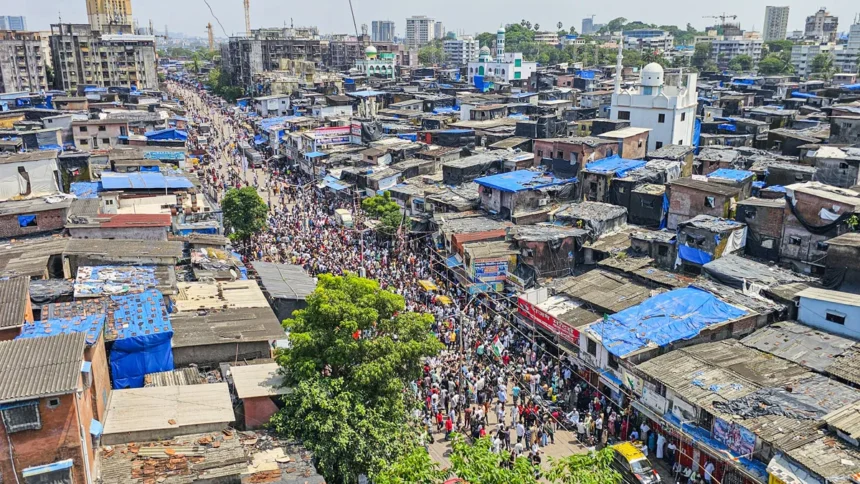
Apart from the economic implications, this shift has significant urban planning and governance implications. Mumbai slum clusters, which accommodate almost 40% of the city’s populace, are no longer considered residential enclaves but dynamic economic systems. Formal acknowledgment of commerce in them, in the form of taxation, could lead the way for policy changes in models of redevelopment and service provision.
Still, the move has also worried small business owners, who see in it a potential source of financial burden. “We are willing to pay tax if it will result in improved roads, sanitation, and consistent electricity,” said one owner of a fabric store in Dharavi. “But the BMC needs to ensure also that small businesses like ours are not penalized or forced out of business for non-compliance we didn’t even know existed.”
Urban economists, meanwhile, see this as a long-term positive shift. By documenting commercial activity in informal settlements, the city can attract more planned redevelopment and credit access for small entrepreneurs. “This is a step toward integrating Mumbai’s informal economy into the mainstream,” said Prof. Anjali Deshmukh, an urban policy expert at Tata Institute of Social Sciences. “If implemented sensitively, it could enhance both governance and growth.”
The decision of BMC also aligns with a larger trend in Indian cities, wherein municipal corporations are under pressure to be financially autonomous. While state and center grants are unpredictable, local resource mobilization through property tax has become the make-or-break factor. In Mumbai, property tax contributes almost 25% of BMC’s annual income, and opening up its base could counteract falling octroi and income from construction.
In the future, the civic organization intends to grow its property-mapping program by utilizing drone surveys and GIS technology to map unregistered properties and commercial activity. This data-driven technique promises to enhance accuracy in tax assessment and suppress evasion.
In essence, Mumbai’s latest property tax push is more than a revenue collection exercise — it’s a structural reform in how the city perceives and manages its informal economy. By bringing slum-based businesses into the official fold, the BMC is laying the groundwork for a more equitable and financially resilient urban future — one where every enterprise, big or small, contributes to the city it thrives in.