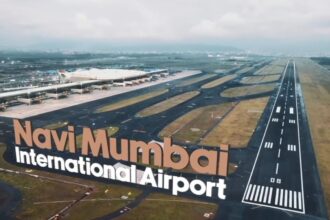
DGCA Grants Aerodrome Licence to Navi Mumbai International Airport: What It Means for India’s Next Big Aviation Hub
In a significant development for India’s civil aviation infrastructure, the Directorate General of Civil Aviation (DGCA) has officially granted an aerodrome licence to the Navi Mumbai International Airport (NMIA). This marks a major milestone in the long-awaited project, setting the stage for commercial operations to begin in the near future.
The Navi Mumbai International Airport Ltd. (NMIAL) — the project’s operator — confirmed the approval in a statement released on Tuesday, September 30, 2025.
What Is an Aerodrome Licence and Why Is It Important?
An aerodrome licence is a regulatory clearance issued by the DGCA, permitting an airport to begin operations and handle aircraft landings, take-offs, and other airside activities.
The licence is granted after comprehensive inspections of airport infrastructure, safety protocols, air traffic systems, runway readiness, and passenger facilities. Essentially, this green signal from the DGCA confirms that Navi Mumbai International Airport has met the required safety and operational standards to start functioning as a commercial airport.
Who Is Behind the Navi Mumbai Airport Project?
The Navi Mumbai International Airport is a joint venture between:
- Adani Group (through Adani Airports Holdings Ltd.) – the airport’s majority stakeholder and operator
- CIDCO (City and Industrial Development Corporation) – Maharashtra’s state town planning and development authority, which is overseeing land acquisition and infrastructure development
Together, they are executing this project in five planned phases, with Phase 1 targeted for completion soon — which will allow the airport to begin operations with limited capacity and then scale over time.
Why Navi Mumbai Airport Matters: A Game-Changer for Indian Aviation
The upcoming Navi Mumbai International Airport is India’s most ambitious greenfield airport project since the construction of the Bengaluru and Hyderabad airports in the early 2000s.
Here’s why it matters:
1. Decongesting Mumbai
Mumbai’s existing Chhatrapati Shivaji Maharaj International Airport (CSMIA) is one of the busiest in the country — operating well over its intended capacity. NMIA will act as a second airport for the Mumbai Metropolitan Region, helping to ease congestion and enhance operational efficiency.
2. Boosting Passenger and Cargo Capacity
Once fully operational across all five phases, NMIA is expected to handle over 90 million passengers annually and significant cargo volume — putting it in the league of global mega airports.
3. Strategic Economic Impact
The airport is projected to generate thousands of direct and indirect jobs, spur economic activity in Navi Mumbai, and act as a catalyst for regional development, including infrastructure, real estate, hospitality, and logistics.
Key Features of Navi Mumbai International Airport
- Location: Ulwe, Navi Mumbai, spread over more than 1,160 hectares
- Runways: Two parallel runways for simultaneous flight operations
- Terminals: Multi-level terminals with modular design for future expansion
- Connectivity: Integrated with the Mumbai Trans Harbour Link (MTHL), Navi Mumbai Metro, and proposed suburban railway connections
- Technology: Smart airport features including contactless check-in, facial recognition, AI-based security, and sustainable design elements
- Green Focus: Designed to be carbon-neutral, with a focus on renewable energy, rainwater harvesting, and efficient waste management systems
What Comes Next?
With the aerodrome licence now in hand, NMIAL can proceed toward final testing, staff deployment, and trial runs. Regulatory bodies will continue to monitor the airport’s readiness in the final stretch before official commissioning.
Commercial flight operations are expected to begin in 2025-2026, with initial domestic routes likely being launched before scaling up to international traffic.
The airport’s launch timeline will also depend on:
- Final clearances from immigration, customs, and CISF (security deployment)
- Airline onboarding and slot allocation
- Navigation and air traffic management readiness
- Coordination with Mumbai ATC for shared airspace
Public and Industry Reaction
The granting of the licence has been welcomed by aviation experts, industry stakeholders, and citizens who have waited years for the airport to become a reality.
The aviation and logistics sectors see the airport as a massive boost to India’s infrastructure capability and a strong move toward making Mumbai a true dual-airport city, much like New York, London, or Tokyo.
Real estate developers and infrastructure investors in Navi Mumbai have also responded positively, as the airport is expected to drive land value and investment in the region.
Final Thoughts: Takeoff Begins for Navi Mumbai’s Dream Airport
The aerodrome licence issued by DGCA is more than just a bureaucratic approval — it is the first official clearance for takeoff in what promises to be one of India’s most iconic infrastructure projects.
With the backing of major players like the Adani Group and the public development support of CIDCO, Navi Mumbai International Airport is now cleared for the final approach toward operations.
As Mumbai continues to grow and the demand for air travel rises, NMIA will not just be a second airport — it will be a symbol of India’s aviation future.