Thane, July 3, 2026: The death of a 17-year-old schoolgirl after she allegedly came in contact with live electricity in rainwater in Thane’s Mumbra area has intensified concerns over public safety during the monsoon. Police have registered a case against officials of Torrent Power Limited over alleged negligence, while residents say repeated complaints about exposed wiring and voltage fluctuations were not acted upon.
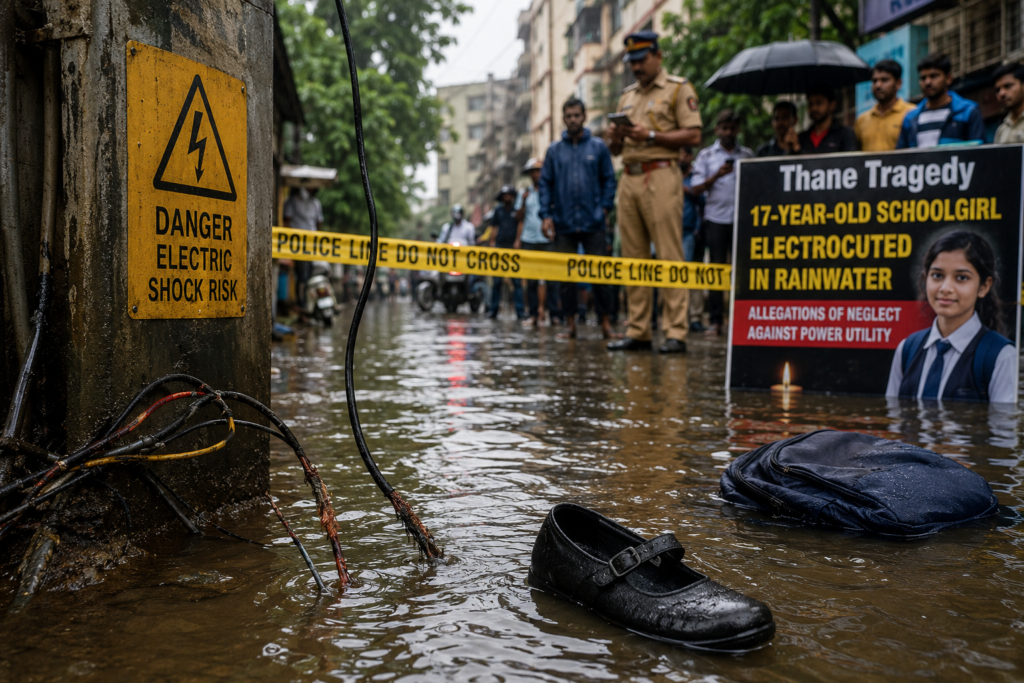
The victim, identified in reports as Aliya Mohammad Sajid Chandiwala, was walking through water collected near the entrance of her housing society in the Kausa area when she suffered a severe electric shock. She was rushed to Bilal Hospital, where doctors declared her dead on arrival. The incident occurred amid heavy rainfall that left several local roads and residential stretches waterlogged.
FIR Filed Against Power Utility Officials
Mumbra Police have registered an FIR against staff of Torrent Power under Section 106(1) of the Bharatiya Nyaya Sanhita, which deals with causing death by negligence. The case is now under investigation, and the police have sent the teenager’s body for a post-mortem examination.
The complaint alleges that live or faulty electrical infrastructure came into contact with accumulated rainwater near the building gate. Such incidents become particularly dangerous during intense rain because water can conceal damaged cables, exposed joints and electrified surfaces from pedestrians. In crowded residential areas, the risk is higher for children, senior citizens and people attempting to cross flooded lanes quickly.
The allegations against the utility have brought focus to maintenance protocols for electrical cables in waterlogged neighbourhoods. Officials will need to establish whether the wiring was properly insulated, whether complaints had been formally recorded and whether timely repair or preventive work was carried out before the monsoon intensified.
Residents Allege Repeated Complaints Were Ignored
Local residents and the victim’s family have alleged that complaints about the electrical line had been raised for weeks. According to accounts cited by news reports, residents said a cable ran through or close to a drain, creating a potential hazard when rainwater accumulated. They claimed requests to secure or raise the cable before the monsoon had not resulted in action.
The family also alleged that voltage fluctuation issues had been reported to Torrent Power from mid-June. These claims are allegations and will be examined as part of the police investigation. The utility’s response and the findings of the technical inspection will be crucial in determining responsibility.
The tragedy has triggered anger in the neighbourhood because the danger was allegedly visible and preventable. Residents have demanded accountability, a full inspection of nearby electrical infrastructure and immediate action against any officials found responsible for failing to address safety complaints.
Monsoon Flooding Turns Electrical Faults Into Deadly Hazards
The incident highlights a recurring monsoon risk in Maharashtra’s urban and suburban areas: waterlogging combined with unsafe electrical infrastructure. Heavy rain can submerge cables, loosen poles, damage junction boxes and expose faults that may not be visible beneath muddy water.
On the same day, a 42-year-old woman was reported dead after allegedly coming in contact with an electrified waterlogged road in Dombivli. Two college students also reportedly suffered electric shocks near Nerul after navigating a flooded stretch where an exposed wire was present.
These incidents underline the need for coordinated action between power companies, municipal bodies, disaster-management teams and local police. During heavy rain alerts, electrical fault complaints should receive emergency priority, particularly in low-lying residential zones where water accumulates rapidly.
Calls for Immediate Safety Measures
Following the Mumbra death, residents have called for urgent inspections of drains, cables, poles and transformers in waterlogging-prone localities. Electrical utilities can reduce risk by isolating damaged lines, repairing exposed wiring, deploying emergency response teams and clearly marking hazardous zones.
For residents, safety experts consistently advise avoiding flooded streets near electrical poles, open junction boxes, hanging wires or damaged streetlights. Any tingling sensation, sparks or unusual electrical sound near water should be treated as an emergency and reported immediately.
Aliya’s death has turned into a stark reminder that monsoon preparedness is not only about clearing drains and managing traffic. It also requires rigorous electrical-safety maintenance, fast response to public complaints and clear accountability when known hazards are left unresolved.