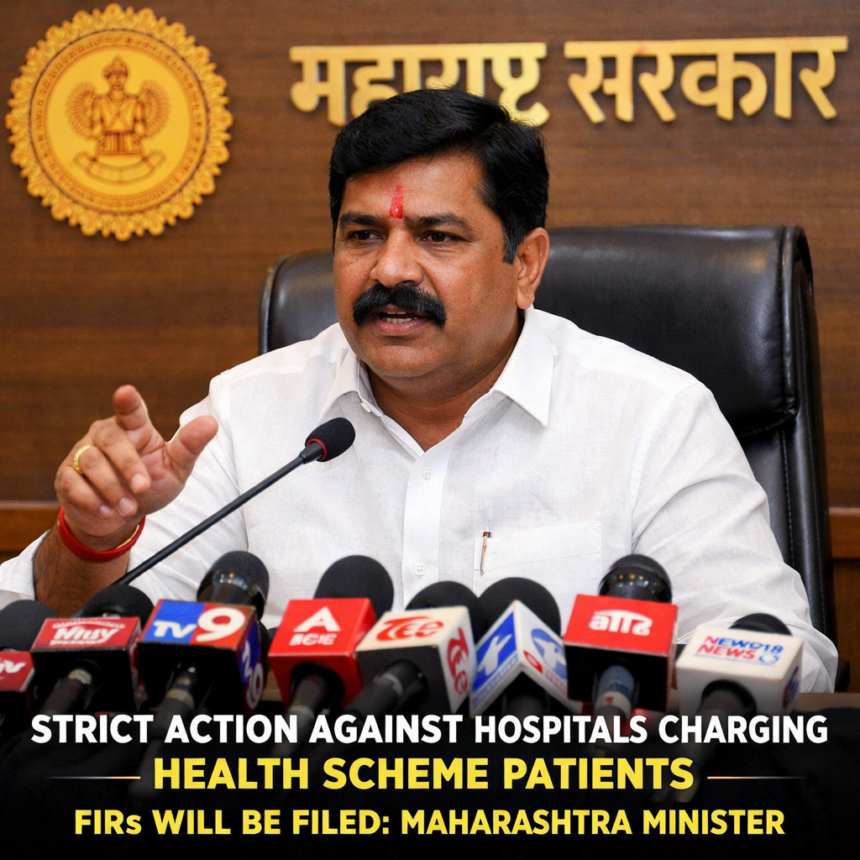
The Maharashtra government has warned hospitals against charging patients covered under government health schemes, stating that strict action — including the filing of First Information Reports (FIRs) — will be taken against violators. The warning was issued by Maharashtra Health Minister Prakash Abitkar during the ongoing state assembly session, where concerns were raised about hospitals demanding money from beneficiaries meant to receive free treatment.
According to the minister, treatments provided under government health programmes such as the Mahatma Jyotiba Phule Jan Arogya Yojana (MJPJAY) and the Pradhan Mantri Jan Arogya Yojana (PM-JAY) are supposed to be fully cashless, meaning eligible patients should not have to pay anything for covered procedures. However, the government has received numerous complaints from patients who were allegedly asked to pay additional charges by private hospitals despite being enrolled in these schemes.
Abitkar informed the House that authorities have examined around 368 complaints of hospitals charging patients illegally. Following these complaints, the state government has already recovered approximately ₹60 lakh in penalties from institutions that violated the rules. The health department has also taken disciplinary action against several hospitals found guilty of such practices.
As part of the crackdown, the minister revealed that 12 hospitals have been delisted from the schemes after being found to have breached guidelines by demanding money from beneficiaries. Delisting means that these hospitals can no longer provide treatment under the government-funded programmes, which are designed to provide free healthcare to economically weaker sections of society.
The health minister stressed that the schemes exist to ensure that poor and vulnerable citizens have access to quality healthcare without financial burden. “Treatment under these schemes is meant to be completely free and cashless,” he said, adding that the government would not tolerate exploitation of patients by hospitals.
He further warned that hospitals repeatedly violating the rules could face criminal action, including FIRs, if complaints continue to surface. Authorities have also urged legislators and district officials to closely monitor the functioning of empanelled hospitals and immediately report irregularities.
To strengthen oversight, the state government has introduced additional monitoring mechanisms. These include district-level committees, led by guardian ministers and local representatives, that will review the implementation of the health schemes every three months. The government is also using artificial intelligence-based monitoring systems to detect suspicious activities and track complaints more efficiently.
The integration of the state’s MJPJAY scheme with the Centre’s Ayushman Bharat programme has also expanded healthcare coverage. Earlier, around 1,356 ailments were covered, but the number has now increased to approximately 2,300 treatments, allowing more patients to benefit from the programme. Eligible beneficiaries can receive treatment worth up to ₹5 lakh per year under the combined scheme.
The minister reiterated that the primary objective of these health schemes is to guarantee accessible and affordable healthcare for the poor. By warning hospitals of legal consequences, the government aims to ensure that patients receive the free treatment they are entitled to without being forced to pay additional charges.