Maharashtra Cabinet Approves Mumbai Metro Line 8
In a major boost to Mumbai’s transport network, the Maharashtra Cabinet has formally approved the ambitious Mumbai Metro Line 8, also called the Gold Line. The Rs 22,862 crore project will offer direct high-speed connectivity between Chhatrapati Shivaji Maharaj International Airport (CSMIA) and Navi Mumbai International Airport (NMIA) for the first time.
Chief Minister Devendra Fadnavis announced that the project will be fast-tracked, with land acquisition to be completed within six months and construction targeted for just 3.5 years.
Faster Travel: 35 km Corridor, 20 Stations
The Gold Line promises to drastically reduce travel time between Mumbai and Navi Mumbai airports. Currently, road travel takes 70–90 minutes, but the metro will cut it to just 30 minutes.
Key Features:
- Total Length: 34.89 km
- Underground Section: 9.25 km with 6 stations (CSMIA T2 to Ghatkopar East)
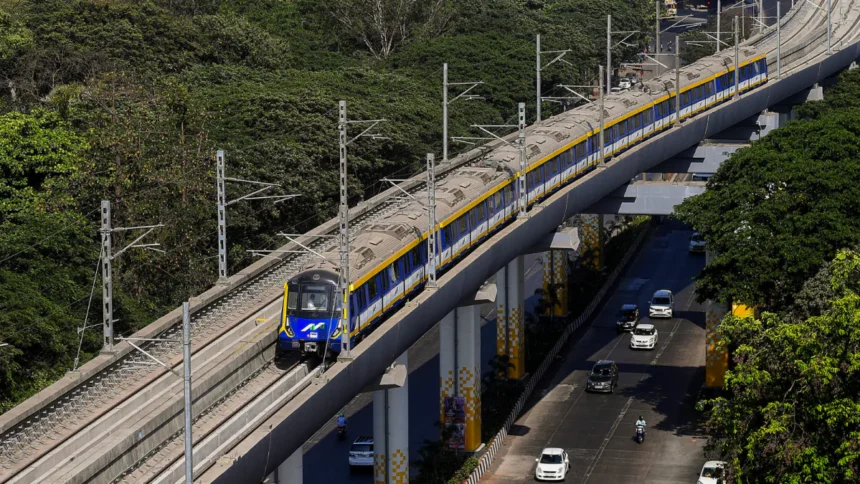
- Elevated Section: 25.64 km with 14 stations (Ghatkopar West to Navi Mumbai)
- Projected Ridership: Over 10 lakh passengers daily by 2031
Strategic Stations and Connectivity
The corridor will feature 20 stations, connecting to six other Metro lines and Mumbai’s suburban rail network, making it a critical artery for the city.
Station List:
- CSMIA Terminal 2
- Phoenix Mall
- SG Barve Marg
- Kurla
- Lokmanya Tilak Terminus (LTT)
- Garodia Nagar
- Baiganwadi
- Mankhurd
- Vashi
- Sanpada
- Juinagar
- LP Junction
- Nerul 1
- Nerul 2
- Seawoods
- Apollo Hospital
- Sagar Sangam (Interchange with Navi Mumbai Metro)
- Targhar
- NMIA West
- NMIA Terminal 2
This route ensures seamless connectivity for commuters, airline crews, cargo operators, and outstation travelers, making it a game-changer for the Mumbai Metropolitan Region.
Financing the Gold Line: The PPP Model
Following the successful Mumbai Metro Line 1, the Gold Line will be implemented under a Public-Private Partnership (PPP) model:
- Viability Gap Funding (VGF): 40% shared equally by the state and central governments (20% each)
- Private Investment: 60% provided by the winning private consortium
The project will be headed by CIDCO, working in collaboration with the private sector, replacing the earlier plan of a joint venture with MMRDA.
Transforming Mumbai’s Airport Connectivity
Once operational, the Gold Line will not only cut travel time between the two airports but also integrate with Mumbai’s growing metro network, suburban rail, and other public transport systems.
With 6 underground stations and 14 elevated stations, the metro promises speed, convenience, and comfort for daily commuters and travelers alike.
Chief Minister Fadnavis emphasized that this project is a key step toward modernizing Mumbai’s transport infrastructure, aligning with the city’s ambition to become a global transit hub.
Looking Ahead
With construction slated for completion in 3.5 years, the Gold Line is expected to revolutionize airport connectivity, reduce traffic congestion, and support the growing population of the Mumbai Metropolitan Region.