Court Discharges Chhagan Bhujbal in Maharashtra Sadan Money Laundering Case
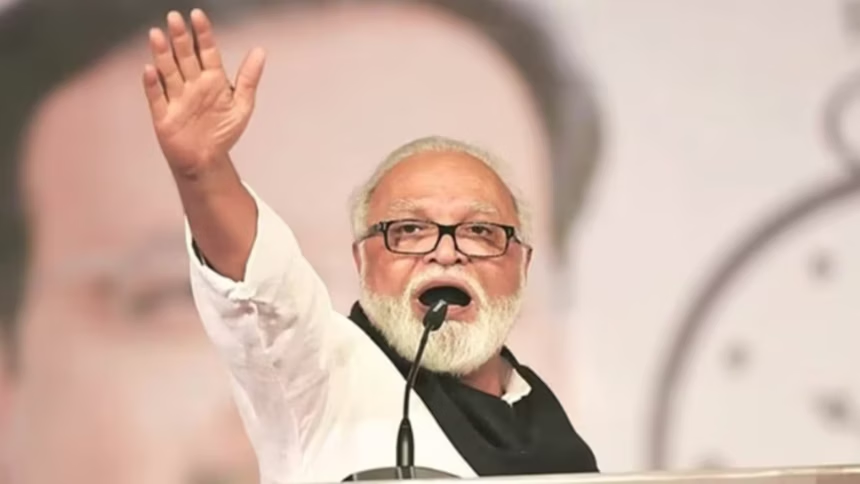
In a major legal relief for senior NCP leader and Maharashtra food and civil supplies minister Chhagan Bhujbal, a special court on Friday discharged him from a money laundering case linked to the construction of Maharashtra Sadan in New Delhi. The decision effectively brings to an end a decade-long legal battle that had once landed Bhujbal behind bars for more than two years.
The special court also discharged Bhujbal’s son Pankaj, nephew Sameer, and several other accused, including well-known Mumbai builder Asif Balwa. The court ruled that the Enforcement Directorate’s case could not survive as the underlying criminal offences, known as predicate offences, had already been dismissed by competent courts.
What Was the Maharashtra Sadan Case About
Allegations Linked to a 2005–2006 Construction Deal
The case dates back to 2005–2006, when Chhagan Bhujbal was serving as Maharashtra’s Public Works Department minister. During this period, a contract was awarded for the construction of Maharashtra Sadan, a state guest house located in New Delhi.
Investigating agencies alleged that the contract was awarded in an irregular manner and that kickbacks were paid to Bhujbal and his family members. According to the Enforcement Directorate, the money was routed through companies where Bhujbal’s son and nephew were directors.
Based on these allegations, the ED initiated proceedings under the Prevention of Money Laundering Act, claiming that the funds received through these transactions were proceeds of crime.
Who All Were Discharged by the Court
Family Members and Builders Get Relief
Along with Chhagan Bhujbal, the court discharged several co-accused in the case. These included his son Pankaj Bhujbal, nephew Sameer Bhujbal, and city-based builder Asif Balwa, among others.
The court accepted multiple discharge applications filed by the accused, concluding that the foundation of the ED’s prosecution no longer existed.
Why the Court Dropped the Charges
Predicate Offences No Longer Survived
Special Judge Satyanarayan R Navandar observed that the entire money laundering case was dependent on earlier criminal cases registered by other agencies. These are known as predicate or scheduled offences under the PMLA.
The judge noted that once these underlying offences were dismissed or failed to stand in court, the money laundering case automatically lost its legal basis.
In simple terms, the court said that if there is no crime proven in the first place, there can be no illegal money generated from it.
Reliance on Supreme Court Judgment
Clear Interpretation of Proceeds of Crime
While delivering the order, the court relied heavily on a landmark Supreme Court ruling in Vijay Madanlal Choudhary vs Union of India. The ruling clarified that under the PMLA, property or money can be considered tainted only if it is directly or indirectly derived from a scheduled criminal offence.
The special court reiterated that in the absence of a proven scheduled offence, there could be no proceeds of crime and therefore no offence under the PMLA.
FIRs That Formed the Basis of the ED Case
ACB and EOW Cases Under Scanner
The ED’s case was built on two FIRs. One was registered by the Anti-Corruption Bureau, while the other was filed by the Economic Offences Wing of the Navi Mumbai police.
The ACB FIR related to alleged irregularities in the awarding of public works contracts, including the Maharashtra Sadan project, an RTO building in Andheri, and a state guest house at Malabar Hill.
The EOW case was linked to a private housing project in Navi Mumbai.
Accused Already Cleared in Underlying Cases
Courts Found No Prima Facie Case
In both the ACB and EOW cases, most of the accused, including Bhujbal, were already discharged by trial courts after detailed hearings.
The special court noted that these discharge orders had attained finality since the state did not challenge them in higher courts. This meant the findings stood legally binding.
Given this background, the PMLA court concluded that continuing the money laundering case would be legally unsustainable.
Origin of the Investigation
Case Stemmed From 2014 PIL
The entire investigation began following a public interest litigation filed in 2014. Acting on the petition, the Bombay High Court ordered a joint inquiry by the Anti-Corruption Bureau and the Enforcement Directorate into allegations against Bhujbal and his relatives.
Based on the inquiry, multiple FIRs were registered in 2015, eventually leading to Bhujbal’s arrest by the ED in March 2016.
Bhujbal’s Arrest and Time in Jail
Over Two Years in Custody
Chhagan Bhujbal was arrested in March 2016 and remained in judicial custody for over two years. During this period, he repeatedly sought bail, citing health issues and delays in trial.
In 2018, the Bombay High Court granted him bail. Three years later, in 2021, the special court hearing the ACB case formally discharged him, stating that no prima facie evidence existed against him.
Only One Case Still Pending
Mumbai University Library Case Remains
With Friday’s order, almost all major cases linked to Bhujbal stand closed. The only case still pending against him relates to alleged irregularities in the construction of a central library at Mumbai University’s Kalina campus.
That case is being handled separately and was not part of the PMLA proceedings.
Political and Legal Impact of the Verdict
A Major Boost for Bhujbal
The discharge comes as a significant relief for Bhujbal, who has consistently denied all allegations and claimed political vendetta behind the cases.
The verdict is also being seen as an important reaffirmation of legal principles governing money laundering cases, especially the requirement of a proven underlying offence.
Legal experts say the ruling strengthens safeguards against misuse of the PMLA in cases where foundational criminal charges do not stand up in court.
A Decade-Long Case Comes to an End
After nearly ten years of investigations, court hearings, arrests, and legal battles, the money laundering case related to Maharashtra Sadan has finally come to a close for Chhagan Bhujbal and his family members.
The court’s ruling makes it clear that without a proven crime, allegations of money laundering cannot legally survive. As Bhujbal moves on from one of the most challenging phases of his political career, the focus now shifts to the lone remaining case still pending against him.