Congress Retains Lead in Bhiwandi Despite Setback in Civic Polls
The civic election results in Bhiwandi delivered a mixed outcome for major political parties. While the Congress suffered a significant drop in seats, it managed to retain its position as the single largest party in the municipal corporation. At the same time, the BJP continued its steady rise, and the Shiv Sena held on to its existing base, setting the stage for intense post-poll negotiations.
With no party securing a clear majority, the results reflect a shifting political landscape in this traditionally Congress-dominated, Muslim-majority town.
Congress Loses Seats but Remains Largest Party
As expected, the Congress saw its strength decline in Bhiwandi. The party’s seat count fell sharply from 47 in the previous election to 30 in the current civic polls. Despite this loss, Congress emerged as the largest party in the corporation, underlining its continued influence in the region.
For decades, Congress has relied on strong minority support and local leadership to dominate Bhiwandi’s civic politics. While that hold has weakened, it has not collapsed, and the party remains a key player in deciding the city’s next governing arrangement.
BJP Expands Footprint in a Traditional Congress Bastion
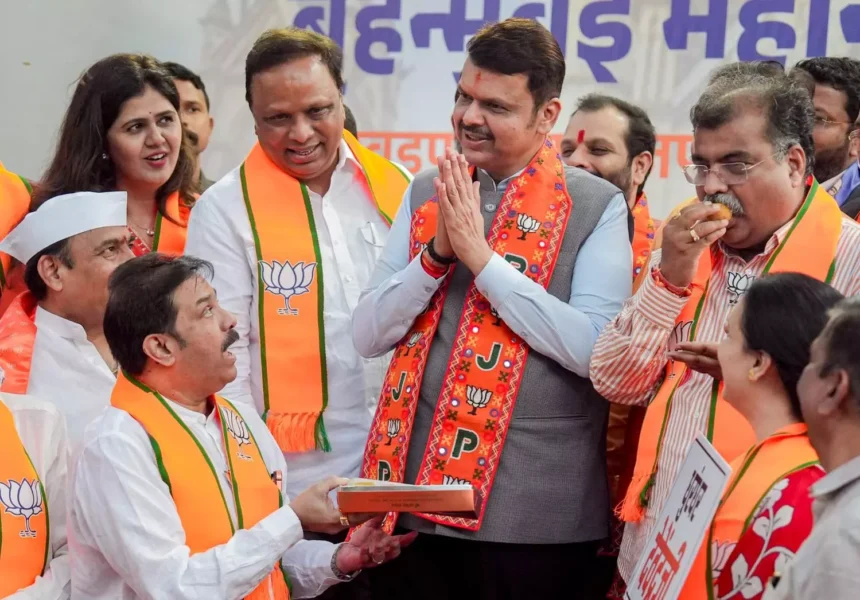
The BJP was one of the biggest gainers in Bhiwandi.
The party increased its tally by three seats, winning a total of 22 seats. This growth, though short of a majority, signals the BJP’s expanding reach even in areas where it once struggled to gain acceptance.
One notable development was the election of six BJP candidates unopposed, a first in Bhiwandi’s political history. This development is being seen as a clear indicator of the party’s growing organisational strength and its ability to consolidate support in select pockets of the city.
Shiv Sena Holds Steady Amid Changing Equations
The Shiv Sena managed to retain its presence in the Bhiwandi Municipal Corporation, winning 12 seats, the same number it held earlier.
While the party did not make major gains, its stable performance ensures it remains relevant in post-election negotiations. Like Congress and BJP, the Shiv Sena will need external support if it hopes to play a role in forming the civic body.
Hung House Likely as Smaller Parties Hold the Key
With no party crossing the majority mark, Bhiwandi is heading toward a hung civic house.
To form the governing body, Congress, BJP, or Shiv Sena will need the support of either the NCP (SP), which won 12 seats, or Independent candidates, who secured 14 seats.
This gives smaller parties and Independents significant bargaining power. Political observers expect intense behind-the-scenes negotiations in the coming days, as alliances are stitched together to gain control of the corporation.
Changing Dynamics in a Muslim-Majority City
Bhiwandi has long been known as a Muslim-majority municipal corporation where Congress traditionally enjoyed a clear advantage by consolidating minority votes.
In the 2017 elections, Congress had won 47 of the 90 wards, while the BJP secured 19 seats, Shiv Sena 12, and the Samajwadi Party just two.
The latest results show that while Congress still leads, its dominance has weakened. The BJP’s growth and the presence of multiple smaller players suggest that voting patterns are becoming more fragmented, driven by local issues, candidate credibility, and organisational strength rather than loyalty to a single party.
Ulhasnagar Sees Neck-and-Neck Battle Between BJP and Shiv Sena
In neighbouring Ulhasnagar, the civic elections produced a sharply contrasting picture.
The contest here turned into a straight fight between the BJP and the Shiv Sena, with both parties contesting all 78 seats. The results were extremely close, highlighting deep political polarisation in the city.
The BJP emerged slightly ahead, winning 38 seats, while the Shiv Sena followed closely with 37 seats.
Role of Omie Kalani Proves Crucial
A key factor in Ulhasnagar’s results was the support extended to the Shiv Sena by Omie Kalani, son of local strongman Pappu Kalani.
Political observers believe that Kalani’s backing played a decisive role in keeping the Shiv Sena competitive against the BJP. Many noted that had Omie Kalani contested separately, the outcome could have been very different, potentially splitting votes and altering the balance of power.
Minor Parties Make Limited Impact
Beyond the two main contenders, other parties struggled to make a mark in Ulhasnagar.
The Vanchit Bahujan Aghadi managed to win two seats, while the Congress was able to secure just one seat. These results underscore how the city’s political contest has largely narrowed to a BJP versus Shiv Sena battle.
The Shiv Sena (UBT)-MNS alliance, despite contesting all seats, failed to win even a single ward, reflecting the alliance’s limited appeal among Ulhasnagar voters.
What the Results Signal for Urban Politics
The outcomes in Bhiwandi and Ulhasnagar together reflect broader changes underway in urban Maharashtra.
In Bhiwandi, Congress remains relevant but no longer dominant, while the BJP continues to expand its footprint even in minority-dominated areas. In Ulhasnagar, the BJP and Shiv Sena appear evenly matched, with individual leaders and local alliances playing a decisive role.
Both cities point to a future where no single party can take urban voters for granted, and coalition politics is likely to remain the norm.
A Fragmented but Competitive Landscape
The civic election results in Bhiwandi and Ulhasnagar underline a more fragmented and competitive political environment.
Congress may still hold the largest block in Bhiwandi, but it faces stronger challenges than ever before. The BJP’s steady rise and the continued relevance of Shiv Sena and smaller parties ensure that power will depend on post-poll negotiations rather than outright victories.
As Maharashtra’s urban politics continues to evolve, these results serve as a reminder that traditional strongholds are no longer immune to change.