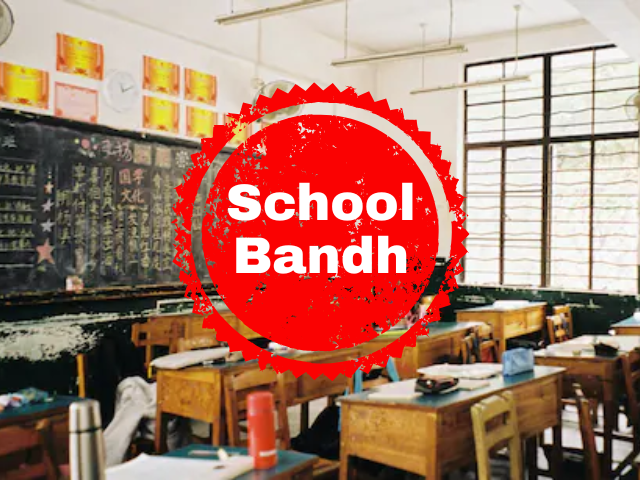
Tensions between the Maharashtra government and school teachers’ unions have sharply escalated ahead of the statewide school shutdown called for 5 December, with the education department issuing a stern warning of one-day salary cuts for staff of schools that remain closed during the bandh.
The order, issued by the office of the Director of Education, has been forwarded to deputy directors, education officers and inspectors of the state. It categorically directs officials to ensure that schools in every category — government, aided, unaided and self-financed — remain open on 5 December, disregarding the strike call given by various teachers’ organisations.
The circular says that if any school is found shut as part of the agitation, the principal, teachers and non-teaching staff will face deduction of one day’s salary. Officials have also been asked to report such cases to higher authorities, effectively putting school managements under pressure to defy the bandh.
Protest over Sanch Manyata policy & TET mandate
However, teachers’ bodies insist they will go ahead with the shutdown, arguing that the government has ignored their concerns for over a year. The 5 December bandh is primarily aimed at opposing the Sanch Manyata policy and the mandatory Teacher Eligibility Test (TET) / CTET requirement for in-service teachers.
Unions say the Sanch Manyata policy, notified through a government resolution in March 2024, allows group recognition of schools and denies staff allocation to institutions with less than 20 students. They fear this will result in the closure of thousands of aided schools, mainly in rural and hilly regions, and will render 20,000-25,000 teachers and other staff effectively redundant.
Besides, the requirement that even experienced teachers should clear TET/CTET to continue in service has met with protests by teachers. Many near their retirement contend that it is unfair to be judged by a new eligibility exam after decades of service.
State School Education Minister Dada Bhuse has sought to distance the government from the TET/CTET mandate, on several occasions saying that it flows from a Supreme Court decision and not from a state-level policy choice. The government has said it is examining legal options, including a review petition, but stopped short of promising any rollback.
On the Sanch Manyata front, the government points out that the Bombay High Court has already upheld the policy in principle while clarifying that no teacher should directly lose his or her job because of it. Officials say the intent is to rationalise staffing, address demographic shifts in student populations and improve resource efficiency.
But the unions argue the reality is quite opposite to these assurances. They point at districts such as Sindhudurg, where already scores of schools have been ordered to shut down and students are being shifted to faraway institutions – increasing commuting time and expense for poor families.
Teachers’ unions call salary threat ‘intimidation’
Leaders of major federations have said that the bandh will go ahead “in maximum strength” despite the circular. Many framed the strike as a battle over the future of Marathi-medium education, saying that the staffing changes, the rules over TET and funding delays can together permanently weaken the ecosystem of aided schools.
The bandh has also found support from several organisations representing school managements -an unusual alignment of teachers and administrators, both of whom say they are reeling under unpaid grants, property tax burdens and rising operational costs.
Parents caught in the middle
The standoff has created confusion for the parents. While some support the teachers’ demands and blame the government for pushing disruptive policies, others worry about lost instructional days and the impact on board exam batches.
The decision presents private schools in urban centers like Mumbai, Pune, and Nagpur with a dilemma on whether to remain open on paper with low attendance or support the bandh fully, risking action. Teachers in smaller towns and villages expect participation to be much higher, with some unions estimating tens of thousands of schools could be affected despite the government warning.
What happens next?
If a significant number of schools also join the shutdown on 5 December, the government will be confronted with a choice between implementing salary cuts across the board and risking further confrontation, or quietly diluting the order to make room for negotiations. Teachers’ groups have already served notice that the 5 December bandh is merely a first salvo. Unless the government rolls back, or amends the most controversial provisions of Sanch Manyata, addresses TET concerns and clears pending dues, longer and more intense agitations are being threatened in the coming months. For now, Maharashtra’s education system stands on edge – with a single day’s protest becoming the focal point of a much deeper conflict over policy, job security and the future of government-aided schooling in the state.