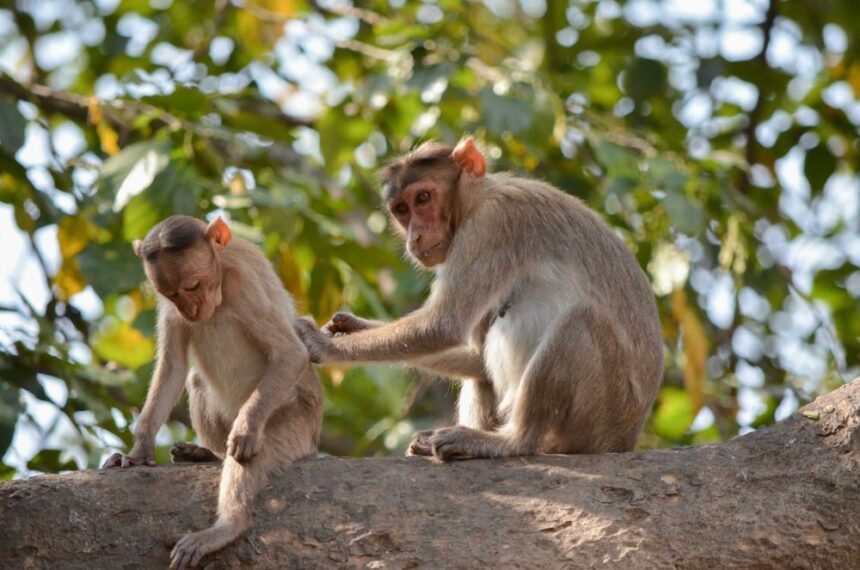
This week, a small troop of monkeys entered into a residential apartment complex in Mumbai’s Powai locality, evoking surprise and discomfort among residents over the rapid loss of green cover across the city. The incident took place in a high-rise housing society close to the Powai Lake belt and has revived conversations around urban-wildlife conflict and environmental stress that is pushing animals closer towards human habitation.
Residents of the building said the monkeys were first seen scaling the façade of the tower in search of food. Some entered balconies and started rummaging through dustbins and food containers, while others attempted to enter the kitchens through open windows. Although no one was injured, the intrusion sent the homeowners into a state of panic, particularly among the senior citizens and families with children.
Local environmental groups have pointed out that Powai, once a rich ecological zone with dense trees and wildlife corridors near the SGNP, has undergone dramatic construction-led transformation over the past decade. With large tracts of land being cleared for new residential towers, roads, and commercial spaces, monkey troops and other wildlife have been losing both food sources and natural resting areas.
Wildlife experts attribute this behaviour to a phenomenon called “habitat compression” where animals’ movement becomes restricted and they have to adapt to the shrinking spaces. “Monkeys generally avoid human interaction when their natural habitat is intact. The moment forests get fragmented, they move towards food-rich areas — and human settlements become an easy option,” says a conservation researcher who works with SGNP.
For Powai specifically, proximity to the national park and gradual depletion of buffer zones have drawn the monkeys closer over the years. Residents in the area remember sporadic sightings over the last two years, but the latest episode — where monkeys managed to climb a multi-storey building and linger for over an hour — is being seen as a worrying escalation.
According to the officials of the BMC and the forest department, they receive several calls every month from eastern and western suburbs reporting such encounters. However, relocation of monkeys is not a long-term solution, according to them, as they mostly return to the same territory. Experts, on the other hand, stress on restoration of tree cover, protection of remaining green belts, and creation of wildlife-friendly zones.
Besides the factor of habitat loss, easy availability of food waste has also been a contributor to such incidents. Open garbage dumps, overflowing bins, or residents feeding stray animals indirectly attract monkeys too. Many times, monkeys that get used to human-provided food become more aggressive after the supply ends.
Housing societies in Powai have now started taking precautionary measures. These involve putting monkey-proof nets on windows, not leaving garbage containers open, and asking residents not to keep fruits or food items in open balconies. Many of the society management committees have asked the BMC for increased vigilance related to waste disposal in the area.
Urban planners contend that the incident in Powai should remind the development authorities in Mumbai to rethink unplanned construction. The green cover of the city has continued to thin-from Aarey Colony encroachments to losses along new road projects-affecting everything from wildlife to air quality, microclimate balance, and general livability.
The Powai case has become a rallying point for environmentalists seeking to revive the urban ecological concern. They propose mechanisms such as mini-protected forests at the neighborhood level, stringent tree-cutting laws, and an ecological impact assessment for every major construction project. “Mumbai cannot afford to treat green spaces as expendable pieces of land. Every lost patch of forest pushes the city further into an environmental crisis,” says an activist. The sighting of a monkey in Powai may not be an isolated one, but it certainly sent out a shockwave in making residents aware of how fragile the coexistence between humans and wildlife has become. Finding a sustainable balance between development and ecological preservation is no longer optional but of urgent necessity in Mumbai as it continues to grow vertically and horizontally.