India’s financial capital, Mumbai, is staring at a renewed air quality crisis as the BMC has initiated one of its toughest crackdowns on construction emissions seen so far. With the Air Quality Index in several city pockets regularly shooting above 200-a level classified as “poor”-authorities have activated enhanced pollution control measures and threatened immediate shutdowns of construction and industrial activities in high-pollution zones. The move signals an urgent attempt to balance fast-paced urban development with public health and environmental sustainability.
Under BMC’s revised pollution control mechanism, if the AQI in any ward stays above 200 continuously, the construction sites within that zone will be ordered to shut down until air quality improves. The protocol comes as part of the city’s implementation of GRAP-4-a far more stringent level of intervention aimed at responding to severe spikes in pollution. For a city with over 1,200 active construction sites-including major infrastructure projects such as metro extensions, commercial complexes and redevelopment initiatives-the ruling is a huge disruption but one considered necessary by environmental experts.
BMC has increased ground-level inspections at construction sites over the past year by deploying ward-level squads consisting of engineers, police, and environment officers. These teams report on compliance with a detailed 28-point checklist to mitigate pollution at each site. Essential measures under the checklist include full-height tin barricades around sites, real-time air quality monitors, on-site misting or fogging to minimize dust, green net coverings over scaffolding, and tire-wash facilities for trucks exiting construction zones. The civic body has warned that any site not adhering to such rules will receive immediate notices, penalties, or a suspension of operations.
Recent checks have found pervasive violations. Even major infrastructure projects were found to be in violation — some for not having dust-suppression systems while others were found to have not installed AQI sensors or allowed uncovered debris movement. This violation assumes great significance as construction dust alone accounts for one of the single largest contributors of particulate matter-PM10 and PM2.5-to Mumbai’s air.
Environmental data supports the urgency of the crackdown. Many monitoring stations across the city, including those at Worli, Bandra, Andheri and Chembur, have recorded sharp rises in particulate levels during peak construction periods. The hazard is compounded in the winter months when cooler air and low wind speed reduce pollutant dispersion, trapping dust and emissions closer to the ground. For residents, especially children, senior citizens and people with respiratory conditions, such exposure can lead to serious health complications – from asthma and bronchitis to cardiovascular stress.
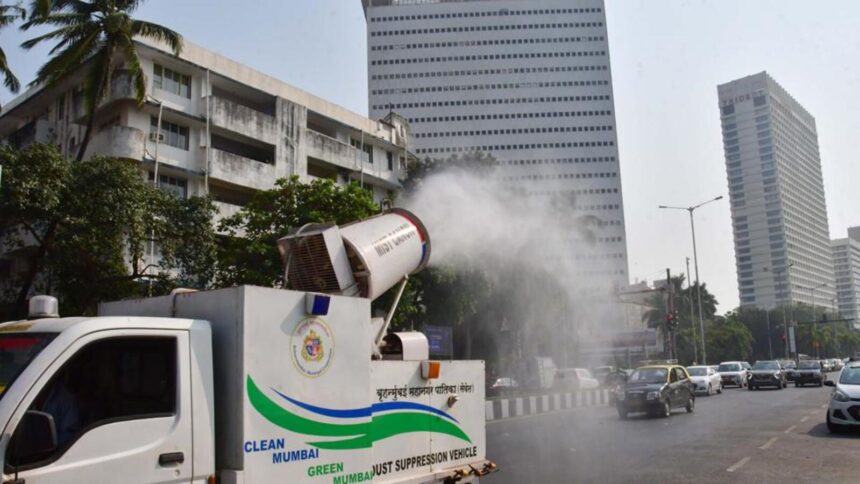
The BMC has also deployed heavy-duty dust-suction vehicles and water-misting units to reinforce its air-quality response. The machines are now regularly deployed along major corridors and construction-dense clusters such as Lower Parel, BKC, Andheri East and the eastern suburbs. Additional measures involve directions to contractors to ensure that transportation of cement, sand and debris is done with the material completely covered. Open burning of garbage-a common menace across numerous construction sites-has been strictly forbidden.
However, the construction industry has raised fears over the economic and logistical fallout of the crackdown. Builders say that while environmental accountability is critical, sporadic shutdowns would have the effect of delaying project completion, increasing costs, and delaying handovers. They claim that pollution-control equipment at sites-such as real-time sensors-have procurement delays given the high demand. Yet, several industry players agree that tighter enforcement is inevitable with Mumbai facing limited green cover, increasing vehicular emissions, and continuous infrastructure expansion.
Urban planners consider the crackdown a correction that’s due. For years, rapid construction has outstripped environmental safeguards, leaving neighbourhoods thick with dust and residents complaining about health problems. The new rules, they argue, could push developers toward better construction practices, including more use of prefabricated materials, cleaner machinery and better site management. Despite all odds, the crackdown marks a turning point in Mumbai’s pollution control policy.
Instead of merely taking post-pollution, reactive measures, the city is moving toward preventive, accountable and data-driven enforcement. If implemented consistently, experts believe such action can seriously cut construction-related pollution and bring overall air quality closer to desirable levels. This balancing act between development and environmental health has to be delicately maintained as Mumbai marches toward its dream of emerging as a global-standard metropolis. But the BMC’s firm stance sends out a clear message: growth in the metropolis cannot come at the cost of breathable air. The coming months will tell how well Mumbai manages this transition-and whether stricter enforcements today can usher in a better, healthier tomorrow.