In a major crackdown to improve the deteriorating air quality in Mumbai, the BMC has halted 1,979 construction projects in various parts of the city for discovering major violations of pollution-control guidelines. The action has been initiated at a time when dust levels in Mumbai continue to rise and the air quality is becoming increasingly toxic, particularly during winters when the particulate matter tends to accumulate.
According to BMC officials, inspections are being conducted over several weeks in all the municipal wards. During the checks, it was found that various under-construction sites were working without basic environmental safeguards on their premises, such as dust barriers, water sprinkling mechanisms, coverings for debris, or proper waste disposal systems. In many places, the construction trucks were also found to transport materials without mandatory covering, leading to dust dispersal on busy roads.
The civic body explained that the action became necessary as construction dust has turned out to be one of the major contributors to Mumbai’s pollution, according to recent studies, as it constitutes almost 30% of particulate emissions. With the Air Quality Index frequently dipping into the “poor” or “very poor” category, BMC has intensified its enforcement of existing guidelines and announced strict penalties for non-compliant builders.
A senior BMC official said, “We found rampant violations despite repeated warnings. Construction companies were not following the mandatory rulebook, and this was directly adding to Mumbai’s air pollution levels. The stoppage orders will remain in place till each site complies with all environmental norms.”
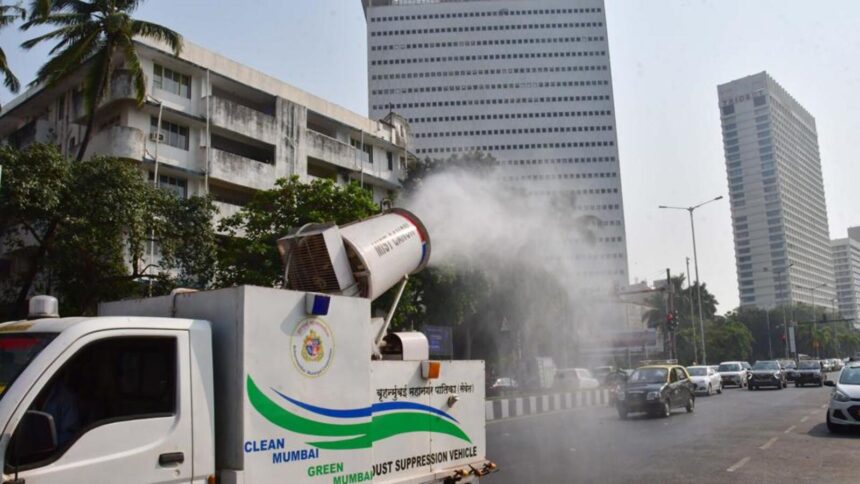
As per the revised BMC guidelines, the construction sites need to install peripheral green nets or barriers for containing dust, provide frequent water sprinkling, ensure on-site wheel washing for trucks, and maintain covered storage areas for sand and cement. The sites are also supposed to deploy anti-smog guns for larger projects. However, the inspections showed a large number of developers had ignored these directives.
These include everything from small redevelopment buildings and residential towers to large commercial complexes and infrastructure works. Many developers had expressed concerns related to project delays, financial losses, and disruption of labour schedules. However, civic authorities have clarified that environmental safety has to be ensured, overriding any commercial inconvenience this may cause. “Construction cannot come at the cost of public health,” the official added.
Environmental experts welcomed BMC’s tough stance, calling it a necessary step in a city grappling with rising pollution levels. “Mumbai’s air quality has sharply deteriorated in recent years. Construction dust is a silent but major pollutant. Stringent action is required,” said an environmental researcher from IIT-Bombay. Citizens, too, have for long complained about dusty roads, worsening allergies, and constant particulate haze over construction-heavy areas such as Andheri, Powai, Lower Parel, and Goregaon.
Public health experts warn that long-term exposure to construction dust, which contains fine particulate matter, or PM10 and PM2.5, leads to respiratory illnesses, aggravated asthma, irritation to the eyes, and even long-term cardiovascular risks. The high density of population and traffic volume particularly exposes Mumbai’s residents to it.
The BMC has issued fresh guidelines to help builders comply and launched training workshops for site managers and contractors to avoid such problems. Officials explained that non-compliance in most of these cases was due to negligence, rather than a lack of knowledge of rules, and greater awareness along with enforcement will achieve faster results. However, builders say too many inspections and sudden stoppages disrupt work flow and have asked for clearer timelines and a compliance grace period-which the BMC has refused to agree to.
Meanwhile, the civic body has deployed additional teams for daily monitoring and surprise inspections, indicating that this is not a one-time action but part of a long-term strategy to curb dust pollution. The BMC is planning to introduce stricter fines and possible blacklisting of repeat offenders.
For citizens, the crackdown offers a reason to hope that sustained enforcement will improve the air-quality levels over the next few months. Mumbai’s AQI has hovered at concerning levels; without immediate interventions, experts fear the city might suffer from chronic episodes of smog much like other northern metros.
Regarding the 1,979 projects on which work has been stopped, builders now need to show full compliance before getting permission to restart. The BMC has sent word that re-creating Mumbai’s air is a priority, and the construction sector, being one of the biggest polluters of the atmosphere, needs to follow environmentally-correct obligations.
The move is among the biggest pollution-control crackdowns in Mumbai’s history, and sends out a strong message: negligence will not be tolerated. Whether this leads to long-term improvement will depend on sustained vigilance from both authorities and builders — and collective commitment to making Mumbai a cleaner, healthier city.
BMC Halts 1,979 Construction Projects Across Mumbai for Violating Pollution Norms

Leave a Comment