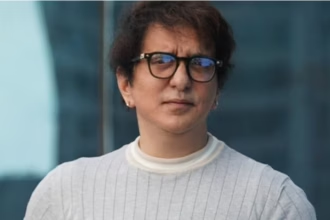
In what is considered a major development in one of the Mumbai’s most high-profile terror-related cases, the Bombay High Court, clearing over a decade of litigation and imprisonment, has granted bail to 65-year-old Kafeel Ahmed Ayub, one of the accused in the 2011 triple bomb blasts that shook the city. The decision, which came after over a decade of litigation and imprisonment, has raised important questions about prolonged pre-trial detention, human rights considerations, and the pace at which terror-related judicial processes move in India.
The 2011 serial blasts took place at three crowded areas: Zaveri Bazaar, Opera House, and Dadar, killing 27 people and injuring more than 120 others. The Maharashtra ATS extensively investigated these attacks and then transferred the case to the National Investigation Agency. Ayub was accused of participating in a conspiracy and providing logistics to people who were allegedly involved in planning and executing these attacks.
But despite the gravity of the charges, the trial has been moving at an incredibly slow pace. As noted by the High Court, Ayub has been in detention for over 13 years, and his trial is still not complete. The court opined that detaining an accused continuously without conviction impinges on constitutional guarantees of a fair and speedy hearing, especially when the accused is advanced in age with health-related complications.
The bench explained that though the nature of the accusations was indeed serious, the legal system cannot allow “detention to become punishment before conviction.” It also noted that the delay in trial proceedings was mostly due to procedural complexities, examination of several witnesses, and the multi-layered forensic investigations characteristic of terror cases. In these circumstances, continued incarceration without any foreseeable end to the trial would be incompatible with fundamental rights under Article 21 of the Constitution.
Ayub’s legal counsel argued that his health has deteriorated significantly over the years due to his age and prolonged imprisonment. They also emphasized that Ayub has consistently cooperated during the investigation and has not attempted to disrupt legal processes. The court agreed that his age and medical vulnerability constitute valid humanitarian grounds for granting bail, provided adequate safeguards are ensured to prevent any risk of absconding or tampering with evidence.
The strict conditions for the bail order are that he surrenders his passport, regularly reports to the police authorities concerned, does not contact any co-accused or witness, and he can also be called upon to remain in a particular jurisdiction unless the court allows him to leave. These measures are intended to maintain the integrity of the ongoing trial while acknowledging Ayub’s prolonged pre-trial detention.
Reactions to the decision have been mixed. Human rights advocates and legal experts have hailed the ruling as a reaffirmation of the commitment to constitutional fairness on the part of the judiciary. They believe the presumption of innocence is one of the sacred tenets of Indian law, and extended pre-trial detention in complex terror cases seriously erodes that principle.
However, families for some of the victims have voiced their dissatisfaction with this move, viewing it as a step backward on the path to justice. They argue that survivors and communities are still suffering emotionally and socially from the attacks, and leniency-even procedural-sends the wrong message in terrorism cases.
Legal experts say the judgment underlines a more profound difficulty inherent in India’s judiciary: the delicate balancing between imperatives of national security and individual rights. Terrorism trials involve bulky evidence, several jurisdictions, and considerable coordination among agencies, which also delays the trials. However, the court’s verdict underlines that the judicial system must keep in tune with constitutional values even in cases involving serious national security concerns. As the trial continues, the case will likely remain under close public and judicial scrutiny. For now, the court’s decision marks an important moment in the intersection of law, human rights, and security, with a continuing need for reforms that ensure timely trials while preserving due process.