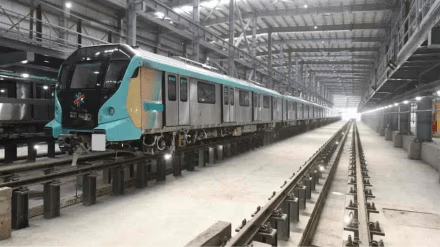
In a path-breaking verdict that reinforces commitment to the inclusive development of public transport in the city, the Mumbai Metro authorities have announced a 25 percent discount on monthly passes for differently-abled passengers. The move, applicable across all operational Metro lines, aims at affordable and accessible day-to-day commuting for individuals with disabilities, a segment often overlooked in urban mobility planning.
This decision was approved in the recently held meeting of the MMRDA, a body that oversees the metro network. The officials maintained that the discount would be implemented from now on, which would help thousands of differently-abled commuters traveling in the metro to go to work, school, and hospitals.
An MMRDA spokesperson announced the policy thus: “Accessibility and inclusion are not optional but form the very base of equitable city development. The concession in fare is a recognition of challenges faced by differently-abled citizens every day and our effort to ensure they are not excluded from the city’s growth.”
The Mumbai metro, which is rapidly expanding with new lines currently under construction, was designed to be more disability-friendly, with features including elevators, tactile flooring, Braille signage, and reserved wheelchair spaces. But disability rights advocates have long argued that economic barriers stand in the way of regular usage. This 25% fare reduction both symbolizes and creates a practical improvement.
For many differently-abled commuters, public transport is a critical link to independence. “Even with accessibility ramps and elevators, the cost was a deterrent to many of us who use the metro daily,” said Pradeep More, a visually impaired professional who travels between Ghatkopar and Andheri. “This concession will help us travel more frequently and with dignity.”
According to the 2011 Census, Mumbai is home to more than 400,000 residents with various disabilities, though advocacy groups believe that figure is much higher today. As fuel prices rise and roads become increasingly congested, metro connectivity provides a much faster and safer option-especially for people who cannot move around as easily.
The fare discount aligns with the broader social inclusion goals of the Government of Maharashtra and India’s Accessible India Campaign (Sugamya Bharat Abhiyan), which seek to make public infrastructure more user-friendly for persons with disabilities. Transport experts see the metro’s initiative as a big contribution toward that vision.
“Affordability is a key component of accessibility. Physical ramps and tactile paths are crucial, but if fares are prohibitively high, many people are effectively shut out. This effort closes the gap on that,” said Transport Analyst Amrita Sinha.
The all-inclusive Mumbai Metro policy sets a precedent for other Indian cities with extensive metro operations, like Delhi, Bengaluru, and Hyderabad. While some metros offer free or concessional single-journey tickets for differently-abled passengers, extending the concession to monthly passes-a decision made by Mumbai-offers consistent and meaningful savings for regular commuters.
Metro authorities have reportedly been working on further initiatives to widen access. These include enhancing last-mile connectivity by deploying low-floor electric buses, improving lighting and signage inside the stations, and training staff to handle differently-abled passengers. A proposal has also been made to integrate digital verification of identity with the metro card system so that eligible passengers get discounts automatically.
Activists, however, also stress that improvements to accessibility should not be merely tokenistic in nature. “While we appreciate the fare concession, a majority of stations still lack properly maintained elevators or tactile indicators that lead directly from ticket counters to platforms,” disability rights activist Nisha Bhagat said. “Real inclusion is grounded in ensuring every stage of the commute-from entry to exit-is safe and dignified.”
MMRDA has assured that a special monitoring team will be constituted to identify gaps in accessibility and for smooth implementation of the fare discount. Feedback would be continuously sought from commuter groups and non-profit organizations working with the differently-abled to fine-tune the policy. With the continuous expansion of the metro network in Mumbai, progress being made on Line 3 Colaba-Bandra-SEEPZ, and Line 9 nearing completion, a modernization chapter for the city’s public transport system has just begun. This fare reduction for differently-abled passengers thus sends a powerful message that economic progress must go hand in hand with empathy and inclusiveness. For a vibrant metropolis like Mumbai, which sees millions relying on public conveyance daily, such moves go beyond mere administrative decisions to a commitment towards civic duty. By making mobility more affordable and equitable, the Mumbai Metro aims to ensure that every Mumbaikar, regardless of physical ability, is able to move through the city with freedom and dignity.