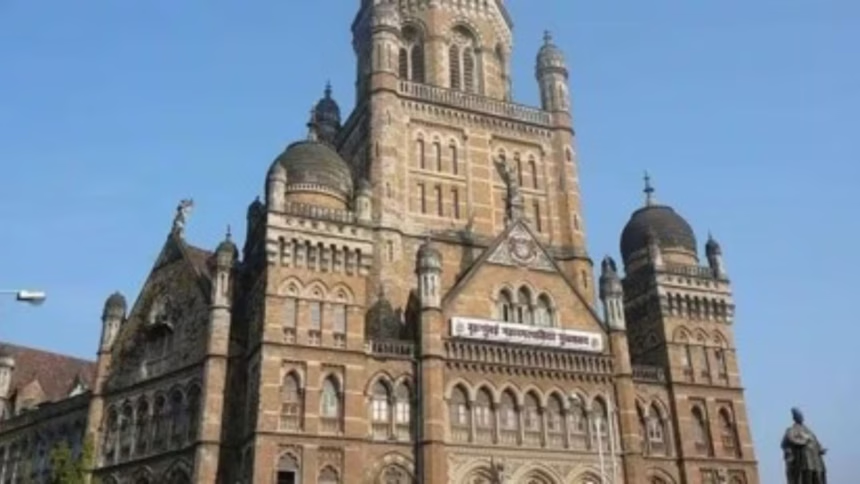
The Brihanmumbai Municipal Corporation (BMC) has pushed back the deadline of its highly awaited auctions of properties to recover long-pending property tax dues from defaulters in the city. The auctions, originally scheduled to be held in early November, have now been rescheduled to give property owners more time to pay their arrears and prevent forfeiture of their properties.
The extension has been given after the civic body received several appeals from individuals as well as commercial property owners requesting additional time to make payments, officials said. The move is at a time when the civic body has a humongous outstanding of unpaid property taxes, pegged between ₹5,000 to ₹6,000 crore, which is complicating the municipality’s plans for funding essential infrastructure and public service schemes.
A top official of the BMC’s Assessment and Collection Department confirmed that the step is as part of a balanced mix of enforcement and cooperation. “We are not looking to penalize anyone, unnecessarily. Our intent is to make all the property owners pay their civic duty. This extension is a last chance for defaulters to pay up their dues before their properties are auctioned,” the official stated.
The company has already served over 3,000 property owners in the city, including some of the prime locations like Colaba, Bandra, Andheri, and Worli. Properties with arrears of over ₹50 lakh will be targeted for the future auctions. After the final deadline passes, the BMC plans to go ahead and auction these properties to recover the due tax amounts.
In recent years, the BMC has struggled to recover property tax dues from large real estate holders and commercial establishments. Some of these defaulters include long-standing disputes over valuation and ownership, while others are cases of deliberate non-payment. The corporation’s data indicates that Mumbai’s property tax is one of its primary sources of revenue, contributing nearly ₹7,000 crore annually. The defaulters’ recovery is vital to the availability of a consistent cash flow for future urban infrastructure projects, such as road repair works, improvement of waste management systems, and flood control measures.
In an attempt to improve transparency and efficiency, the BMC has overhauled its auction process by adopting an online platform through which one can participate. Potential purchasers can now see extensive descriptions of the properties, including their opening price, address, and unpaid dues, on the BMC’s portal for e-auctions. The initiative will help draw investors from all over Mumbai and other cities seeking to invest in the real estate sector, especially since a few of these properties are situated in high-end areas.
The residents’ associations, though, have requested the civic body to approach the process with sensitivity and transparency. “While the BMC effort to recover dues is understandable, it is also essential that the auctions are held transparently and property owners are given advance notice. There could be many small property owners who were unaware of the seriousness of the situation,” said Anil Mehta, an official of the South Mumbai Housing Federation.
Such property auctions have been found by economic analysts to have a twofold effect. While, short-term wise, they instill financial responsibility in property owners and improve the fiscal health of the civic body, large-scale auctions may temporarily swell the real estate market, impacting property prices in specific locations. But with the steady demand for property in Mumbai, particularly in central and suburban pockets, the overall impact on the real estate space will be minimal, experts are convinced.
The fact that the deadline extension was done at the threshold of Diwali is also thought to be a strategy. This gives property owners an opportunity to dispose of assets or clear dues during the festival time rather than being subjected to punitive action. An official in BMC opined that this last extension is not likely to precede another, pointing out that properties of chronic defaulters will be attached and sold without notice.
As the new deadline will add two to three weeks to the process, the BMC is expecting to collect a lion’s share of the default amount by the financial year-end. The civic body is also contemplating partial payment schemes for small defaulters to prompt faster compliance.
By granting this final window, the BMC aims to strike a balance between firmness and fairness—ensuring that Mumbai’s taxpayers are given a fair chance to comply, while reinforcing that non-payment will ultimately lead to serious consequences. As the city continues to expand and modernize, maintaining financial discipline through timely tax collection remains key to funding the very civic improvements that make Mumbai India’s financial capital.