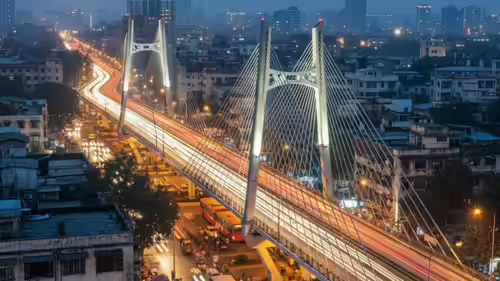
The Brihanmumbai Municipal Corporation (BMC) collaborated with the Maharashtra Rail Infrastructure Development Corporation (MRIDC) to announce a large infrastructure initiative in South Mumbai: a new road-over-bridge (ROB) / cable-stayed flyover at Byculla that will be a major east-west connector spanning key traffic corridors.
The flyover would connect the old “Y-Bridge” at Byculla with the JJ Flyover and the Olivant Bridge / Mazgaon corridor, thus avoiding several main congested junctions.
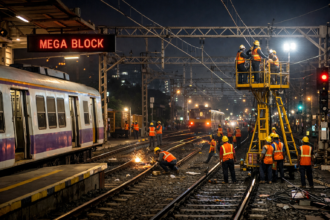
The work is being executed in stages to avoid disruption in a highly trafficked area of the city that also has busy railway lines below.
Key Features & Technical Specs
The new flyover will replace or substantially upgrade the older Byculla Y-Bridge that is of 1922 vintage and had been found to be unsafe in Indian Institute of Technology Bombay audit.
Design metrics:
Total length along with access roads approx. 916 meters (1,182 m full corridor as per some reports).
The carriageway will be increased to eight lanes (from six in the present bridge) to facilitate high volume traffic.
The height clearance / deck height is around 9.70 metres from ground level in some sections.
The cable-stayed scheme has been adopted to minimize piers over congested railway lines and a high urban density setting with minimum interference with land- and rail-sea areas.
Other features are aesthetic lighting, a “selfie-point” viewing spot (to turn the building into a city landmark), and utility ducts/modern infrastructure integral to the design.
Cost & Timeline
The cost quoted in one report is estimated at around ₹805 crore for a variant of the project connecting Byculla’s Y-Bridge with JJ Flyover and Mazgaon arms.
Project status: late October 2025, it has completed approximately 72%. Deadline pushed, with an aim now of May 2026 for completion of full operational opening.
Earlier stages are being carried out in a way such that traffic still passes through while construction (i.e., structures parallel to each other constructed prior to demolition of old bridge).
Strategic Importance & Impacts
Traffic decongestion: The corridor being addressed is one of Mumbai’s major choke-points — the Lalbaug / Mazgaon / Byculla axis. Once operational, the flyover is expected to significantly reduce journey times for motorists travelling east-west across the island city.
Connectivity improvement: By offering a more direct connection from Byculla to the Eastern Freeway and neighboring corridors, it enhances the arterial network of Mumbai and facilitates easier movement of goods and people.
Urban renewal & landmark infrastructure: The project is not merely a roadway — the cable-stayed design, the appearance, and the fact that it replaces a bridge from the last century all mean that it adds to the city’s newer infrastructure image.
Safety & longevity: Since the previous bridge was deemed unsafe, the new one removes structural risk, enhances reliability, and incorporates advanced utility corridors and design features.
Challenges & Considerations
Delays & deadline adjustment: As indicated earlier, the project has witnessed numerous schedule delays (originally planned for sooner) owing to intricate urban limitations such as underground services, heavy rail/road environment, and land/accommodation challenges.
Construction impact: Regardless of phased construction, there will be traffic diversions, disruption, and provision for cost and schedule overruns owing to the intricacy. The authorities will have to manage commuter expectations appropriately.
Complementary infrastructure: A flyover, as effective, is merely a component of larger mobility solutions. For lasting gains, complementary investment in public transport, non-motorised transport and last-mile connectivity will be important. There are suggestions of local concerns regarding flyover-dominant approaches.
What to Watch For
Official date of opening and the extent of the transition (i.e., redirecting traffic from the old bridge onto the new, dismantling old span).
Monitoring of traffic time-savings once operational — will expected benefits be realised?
How the structure integrates with adjacent projects (e.g., Eastern Freeway, transit infrastructure, smart city initiatives).
Maintenance and durability given heavy usage; long-term performance of the cable-stayed design in an urban, coastal, high-stress environment.
Conclusion
The Byculla cable-stayed flyover project marks a significant milestone for Mumbai’s infrastructure — bridging heritage, urgent traffic needs, and modern engineering in one. If delivered on time (or near-time) and integrated well into the city’s broader transport ecosystem, it holds promise to meaningfully ease mobility in a key corridor, improve urban aesthetics and safety, and elevate the stature of Mumbai’s internal linkages. The next few months will be critical in observing its transition from construction to full-scale operation.