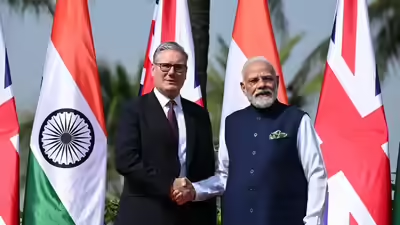
In an important diplomatic interaction to further bilateral ties, Indian Prime Minister Narendra Modi received United Kingdom Prime Minister Keir Starmer in Mumbai today. The encounter was the first official trip of Prime Minister Starmer to India since he assumed office at the start of this year and highlighted the evolving strategic alliance between the two countries.
In the high-level talks, both the leaders reaffirmed their determination to enhance economic, defense, and tech cooperation. The discussions centered mostly around taking forward the India–UK Free Trade Agreement (FTA), deepening defense cooperation, and increasing investments in key areas like renewable energy, digital innovation, and education.
Taking forward the Free Trade Agreement
The long-pending India–UK Free Trade Agreement, under negotiations for more than two years, was the prime focus of the talks. Both the countries remained positive about concluding the agreement soon and pointed towards the huge scope it offered for bilateral trade expansion.
Prime Minister Modi emphasized India’s economic reforms and emergence as a growth driver for the world, appealing to British businesses to invest in infrastructure, green tech, and manufacturing under the “Make in India” initiative.
Prime Minister Starmer, on his part, reiterated the UK’s resolve to enhance its economic influence in India, saying that the partnership “has huge potential for mutual prosperity.” He also underscored the need for establishing robust supply chains and boosting cooperation among startups, universities, and tech companies from both countries.
“The United Kingdom and India have not just a historic connection but also a contemporary, outward-looking partnership founded on innovation, shared democratic values, and trust,” Starmer added in a joint speech. “We want India to be an important partner for us in designing the global economy of the future.”
Strengthening Defense and Security Ties
The two leaders also talked about defense cooperation underlining joint research, production, and technology sharing. Both countries reiterated that they were committed to maintaining stability in the Indo-Pacific region and responding to evolving global security challenges.
Officials signaled that the nations are considering new agreements to co-develop defense technologies and carry out joint military exercises. These efforts fit into India’s desire for enhanced self-reliance in defense production while allowing the UK to advance its strategic presence in the region.
Concentration on Climate and Clean Energy
Climate change and sustainable development were also high on the agenda of the negotiations. The UK and India committed to intensifying cooperation under their Green Growth Partnership, which facilitates collaborative investments in green hydrogen, electric mobility, and renewable energy initiatives.
Prime Minister Modi underlined that India is still committed to realising its goal of a net-zero carbon economy by 2070 and appreciated the UK support for the development of clean energy infrastructure. Both the leaders agreed that partnerships in climate finance and technology would be crucial to meeting the sustainable goals of the world.
Education, Culture, and People-to-People Ties
Aside from defense and trade, the talks also covered education and cultural exchanges. Both parties announced new scholarships and student mobility initiatives to push for academic cooperation. The UK and India are also set to co-host cultural events in 2026 marking 80 years of diplomatic engagement.
The leaders praised the Indian community in the UK—currently standing at over 1.6 million—for its success and its position as a bridge between the two countries.
Business Community Engagement
Prime Minister Starmer’s visit involved a roundtable meeting with prominent Indian business leaders and British investors in Mumbai, where the focus was on increasing bilateral investment and startup partnership. A number of business leaders from industries like fintech, pharma, and manufacturing were confident that the FTA would open up new growth avenues.
Industry experts have called the meeting a “turning point” in India–UK ties. “Both nations are eyeing a relationship that extends beyond trade — one that includes innovation, sustainability, and security,” observed Dr. Meera Deshpande, a senior fellow at Observer Research Foundation.
Prime Minister Starmer’s trip to India constitutes a new era in UK–India relations, bringing strategic purpose and economic aspiration together. With negotiations on the Free Trade Agreement in the final stages and both countries determined to grow cooperation across various fronts, the relationship is set to be one of the most significant world alliances of the decade.
As the two leaders left Mumbai, their message was unmistakable: the India-UK relationship is not merely one of common history, but one of creating a common future founded on innovation, on trust, and on mutual growth.