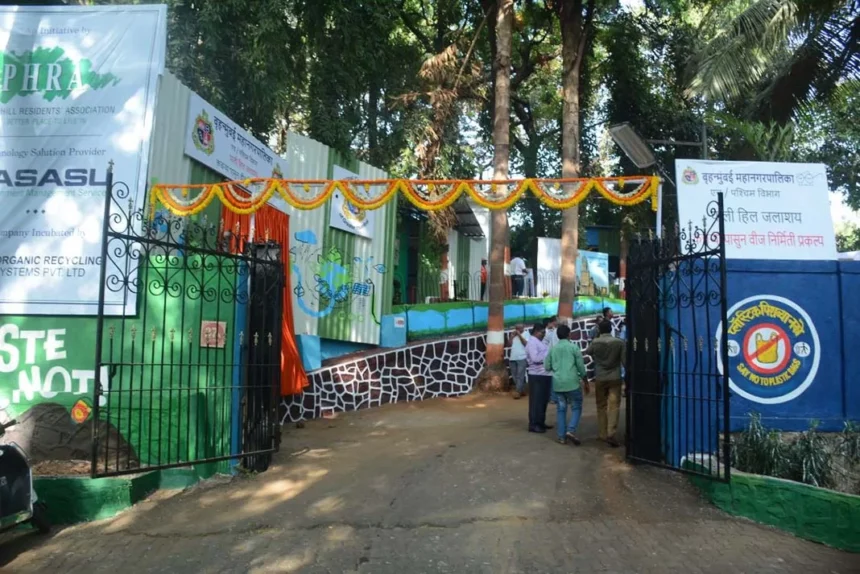
Mumbai’s Pali Hill, one of the city’s most prominent residential localities, is witnessing disappointment among residents and environmentalists as its acclaimed community biogas plant—once hailed as a model for sustainable urban waste management—has been shut down after eight years of continuous operation. The project, which converted organic household waste into biogas to power streetlights and local utilities, was considered a benchmark for decentralized green initiatives across Indian cities.
The biogas plant, set up in 2017 at Pali Hill in Bandra, processed wet waste collected daily from around 70 residential buildings and 23 standalone bungalows. The plant generated biogas, which was used to illuminate nearly 69 streetlights in the area and power nine additional lights at a nearby water reservoir. The initiative not only helped reduce the volume of organic waste reaching Mumbai’s already overburdened dumping grounds but also inspired similar models across Maharashtra.
Its success, according to residents and local authorities, was due to a successful collaboration involving the Brihanmumbai Municipal Corporation (BMC), residents’ associations, and one private agency for waste management. Yet in October 2025, the agency running the project declared that maintaining the project was now “financially unviable” due to escalating maintenance expenses, decreased efficiency, and poor segregation of waste at source.
The shutdown has raised alarm among residents, who contend that the shutdown of the facility is a blow to the sustainability efforts of Mumbai. “This project was our pride,” declared Pali Hill Residents Association member Meera Desai. “It demonstrated that a group can own up to waste and make something out of it. The abrupt closure is like the end of an experiment in going green.”
The Bandra biogas plant had previously been nationally recognized at the Swachh Survekshan Awards 2019 as one of India’s finest decentralized waste management examples. It was commended for minimizing carbon emissions and as a zero-waste model showing how urban populations can be managed wet waste locally without relying completely on civic infrastructure.
Even so, operational problems had been piling up for months. Officials divulged that maintenance of equipment had gone up significantly, and biogas production fell because of improper segregation of wet and dry waste by residents. The agency managing the plant allegedly incurred losses as the expenditure of running and transporting segregated waste went above generating revenue.
A top BMC official in the Solid Waste Management department confirmed that the civic corporation knew of the plant’s travails. “The agency had been asking for additional funding or subsidies to keep the operations going. We are currently considering possibilities of either restarting the project with a new operator or incorporating it into a larger waste-to-energy scheme under the Mumbai Climate Action Plan,” said the officer.
Environmental activists were disappointed and labeled the shutdown as a lesson for other municipalities thinking of taking similar steps. Urban ecologist Dr. Ramesh Nair said, “Community-based biogas projects are the way forward for sustainable waste management in cities such as Mumbai. But for them to become successful, ongoing civic support, funds, and community engagement are essential. When segregation collapses or when incentives cease, such schemes cannot survive.”
Residents have already begun signing petitions calling on the BMC to reopen the plant under a new business model, perhaps through public-private partnerships or CSR-based finance. Several think that with increased awareness programs and better infrastructure support, the Pali Hill plant can be resurrected.
The shutdown also leaves wider questions regarding the sustainability of green community initiatives in urban India in the long run. In spite of their ecological advantages, these initiatives tend to fail because they receive inconsistent funding, experience policy loopholes, and see fewer citizens as active participants. As Mumbai works towards achieving its sustainability goals as part of its 2030 action plan, specialists caution that ignoring small-sized green initiatives may undermine bigger green agendas.
For the moment, the spotlighted Pali Hill biogas plant remains in silence—a testament to the potential and vulnerability of local environmental ingenuity. What had been a shining model of citizen-driven transformation has faded, leaving behind important learning points on the importance of more robust support infrastructure to prop up community-driven sustainability models.
If revived, the project would again serve as a shining example of inspiration for other neighborhoods, demonstrating that civic partnership and shared responsibility are still the solution to cleaner, greener cities.